In brief
Ukraine has entered into a historic agreement with France to acquire up to 100 Rafale F4 fighter jets, enhancing its defense posture against ongoing Russian aggression. The deal, finalized during a meeting between Ukrainian President Volodymyr Zelensky and French President Emmanuel Macron, aims to expedite military support to Ukraine amidst increasing threats. The first deliveries are expected to be completed by 2035, alongside the introduction of interceptor drones. The agreement represents a long-term strategic partnership, though financial parameters and logistics remain under discussion.
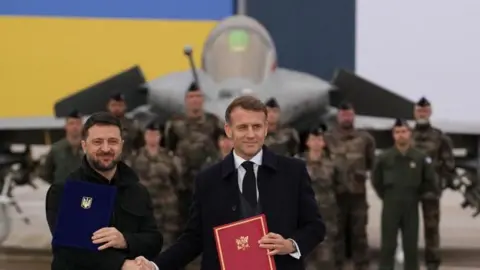
Ukraine will receive up to 100 of France's Rafale F4 fighter jets as well as advanced air defense systems in a major deal to boost Kyiv's ability to protect itself against deadly Russian attacks.
Ukrainian President Volodymyr Zelensky hailed the move as historic, after signing the letter of intent with his French counterpart Emmanuel Macron at an air base near Paris.
Deliveries of the Rafale F4s are planned to be completed by 2035, while the joint production of interceptor drones is starting this year.
Financial details are yet to be worked out, but reports say France plans to attract EU financing and also access frozen Russian assets - a controversial move that has split the 27-member bloc.
This is a strategic agreement which will last for 10 years starting from the next year, Zelensky said at a joint briefing with Macron on Monday.
Ukraine will also get very strong French radars, eight air defense systems and other advanced weaponry, he added.
Zelensky stressed that using such advanced systems means protecting someone's life... this is very important.
Russia has in recent months increased its drone and missile attacks on Ukraine, targeting energy and rail infrastructure and causing massive blackouts across the country. Dozens of civilians have been killed in the strikes, in what Kyiv and its Western allies describe as war crimes.
In the latest overnight Russian missile attack, three people were killed and 15 injured in the north-eastern city of Balakliya, local officials said.
Speaking alongside Zelensky, Macron said: We're planning Rafales, 100 Rafales - that's huge. That's what's needed for the regeneration of the Ukrainian military.
The French president added that he wanted to help Ukraine prepare for whatever was coming next.
These fighter jets are seen as crucial to protecting Ukraine's skies, as the country struggles to prevent long-range air strikes on its border towns and cities.
The Russians are using 6,000 glide bombs per month, warned Serhiy Kuzhan, a Ukrainian defense analyst. It would be important to have a French air-to-air system, with a 200km range, because Russians have their own system with a range of 230km.
While this announcement between Kyiv and Paris is significant, Justin Bronk from the Royal United Services Institute (Rusi) pointed out that the difference they will make depends on the timeframe and the missiles that come with them.
This is a long-term political agreement rather than a detailed purchase order, so few are expecting this announcement to dramatically change the dynamics of Russia's grinding invasion.
The promises of Western military hardware are also only as effective as the training and logistics they come with. Whether it's a German-made Leopard 2 tank or an American F-16 fighter jet, they all require intensive training, sizable support crews, and plenty of spare parts.
Questions remain around financing this deal. It's thought France will dip into its own budget contributions for Kyiv, alongside looking at joint EU borrowing mechanisms.
In conclusion, after France, Zelensky plans to travel to Spain to seek further military and support for Ukraine. He has already secured a gas deal with Greece for vital supplies of US liquefied natural gas to flow into Ukraine this winter.