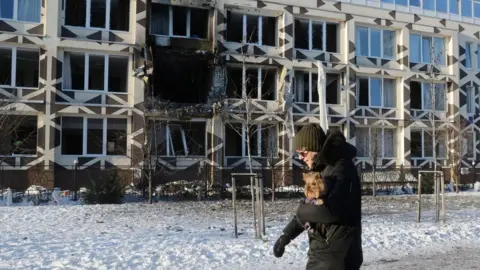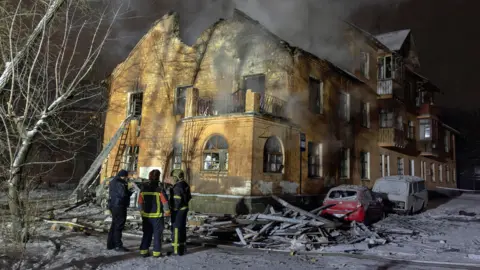
In a significant and alarming escalation of military tensions in the region, Russia has confirmed its deployment of the Oreshnik missile during a massive overnight strike against Ukraine. The missile attack, carried out on Thursday night, has left four people dead and 25 others wounded in Kyiv, where residents reported an extended series of loud explosions.
This marks only the second occasion on which Moscow has utilized the Oreshnik missile, which was first deployed against the central city of Dnipro back in November 2024. The Russian defense ministry has stated that this latest attack was a direct response to a purported Ukrainian drone strike targeting President Vladimir Putin's residence in late December—an accusation Kyiv firmly denies.
While the defense ministry did not detail the specific targets struck by the Oreshnik, reports from various sources indicated that there were numerous explosions reported on the outskirts of the western city of Lviv, approximately 60 km from the Polish border. Ukrainian officials confirmed damage to infrastructure in the city, which further escalates concerns about security in the region.
The Oreshnik missile is characterized as an intermediate-range and hypersonic ballistic missile, capable of covering distances up to 5,500 km. Its warhead has a unique design that fragments upon descent, unleashing a series of explosions that can devastate a wide area.
Ukrainian Foreign Minister Andrii Sybiha emphasized the gravity of this attack, suggesting it poses a significant threat to European security and serves as a test for the transatlantic community. He decried the strikes as a reaction to what he described as 'Putin's hallucinations' regarding the alleged drone attack.
While the European Union has expressed skepticism regarding the validity of Russia's claims about the drone strike, geopolitical tensions continue to rise as missile and drone attacks escalate within the conflict.
On the same night as the missile attacks, the capital was targeted with more than a dozen missiles and hundreds of drones, with one paramedic among the fatalities as he attempted to assist victims from an earlier strike. Mayor Vitali Klitschko reported a 'double-tap' tactic being used, where subsequent strikes target first responders.
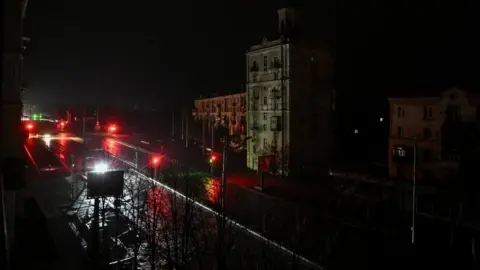
Infrastructure attacks have become a common tactic in this ongoing war, as missile strikes disrupt power supplies and heating systems amid severe winter conditions in Ukraine, where temperatures are expected to plunge to -15C (5F). Concurrently, Ukrainian strikes targeting Russian energy facilities have also resulted in outages in regions bordering Ukraine, including Belgorod.