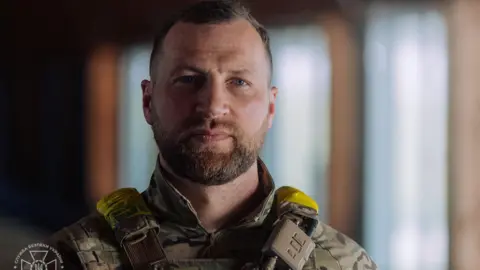
President Volodymyr Zelensky has reshuffled the leadership of Ukraine's Security Service (SBU), replacing influential Vasyl Malyuk and nominating Maj-Gen Yevhenii Khmara as acting head.
The SBU is primarily concerned with internal security and counter-intelligence and, since Russia's full-scale invasion in 2022, it has also played a prominent role in assassinations and sabotage attacks deep inside Russia.
Malyuk, who had run the SBU since 2022, gained a reputation for overseeing successful operations against Russia and for purging the SBU from alleged Russian double agents.
The reshuffles are the latest in a long series made by Zelensky since the start of the war.
Malyuk's name is well-known across Ukraine. Last June, he coordinated the daring Spider Web attack, which saw over 100 Ukrainian drones strike air bases deep inside Russian territory. Khmara, his replacement, was also involved in preparing that operation.
However, Malyuk's dismissal has been widely criticized within Ukraine, including by high-profile military commanders. The decision by President Zelensky is viewed by some as short-sighted, especially since reports indicate that Malyuk initially refused to resign voluntarily.
Even after his dismissal, Malyuk has been tasked with continuing leadership of special operations against Russia, an area in which Zelensky noted he excels.
Khmara's appointment has calmed some concerns about the SBU's future effectiveness. Still, former SBU operative Ivan Stupak has indicated that while Khmara has a solid reputation, it remains unclear whether he can manage the broader SBU effectively.
Some analysts believe Malyuk's dismissal is linked to the appointment of former spy chief Kyrylo Budanov as Zelensky's new chief of staff, alleging that Budanov influenced the decision heavily.
On the other hand, political analyst Oleksandr Notevskyi praised Khmara's nomination, citing his experience as head of Alpha, an elite division in the SBU. Notevskyi believes that Khmara's skills will be essential as Ukraine continues to engage in asymmetric operations against Russian military capabilities.
However, Khmara's appointment is still subject to approval by the Ukrainian parliament, which could reject it. Recent months have shown that while Ukraine struggles to make significant gains on the battlefield, it has been able to target Russian supply lines and military assets with increasing precision.
As the war in Ukraine continues, the effectiveness of leadership changes within the SBU and other military branches remains a focal point for analysts and observers, especially given the complex dynamics of ongoing conflict with Russia.
Recent reshuffles by Zelensky raise questions of effectiveness during a critical period of the war, with comparisons drawn to a football manager running out of substitutes amid ongoing challenges on the battlefield.
Additional reporting by Volodymyr Lozhko and Anastasiia Levchenko