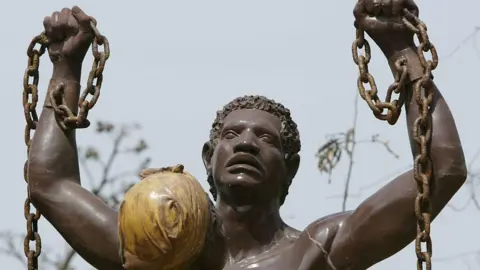
In brief
The UN General Assembly recently passed a resolution labeling the transatlantic slave trade as 'the gravest crime against humanity.' Supported primarily by African and Caribbean nations, the resolution aims to promote discussions regarding reparations and officially acknowledges the immense suffering endured during this dark chapter of history. Despite being non-binding, the resolution may serve as a catalyst for reparative justice and acknowledgement of historical injustices faced by descendants of enslaved individuals.
The United Nations General Assembly this week overwhelmingly backed a resolution declaring the transatlantic slave trade 'the gravest crime against humanity'.
Welcoming the vote, UN Secretary-General Antonio Guterres said that the wealth of many Western nations was 'built on stolen lives and stolen labour'.
Noting the 'barbaric punishments that maintained control - from shackles and iron collars to flogging and sexual violence', he said it 'was not simply forced labour'.
'It was a machinery of mass exploitation and deliberate dehumanisation of men, women and children. The wounds run deep and often go unrecognised.'
The resolution, backed by African and Caribbean countries, is not legally binding but analysts say it sends a powerful message. 'It is already a huge and significant step in political terms to have this debate at the UN, even when it has a more symbolic value,' Almaz Teffera, a senior researcher on racism at Human Rights Watch, told the BBC.
She says it could increase the chance of progress on discussions about reparations, or some form of compensation.
The resolution was adopted by 123 votes to three, while 52 countries abstained, including the United Kingdom and EU member states.
The United States, Argentina, and Israel voted against it.
Dr. Erieka Bennett, who leads the Ghana-based Diaspora African Forum, told the BBC the vote had a personal meaning for the descendants of people who were enslaved, like her.
'It means that I'm acknowledged, it means that my ancestor finally rests. For me personally as an African American I'm overwhelmed - until you've been a part of what happened, it's very difficult to understand what this really means.'
Countries affected by slavery have been asking for reparations for more than a century. But the debate has intensified in recent years, particularly after some nations and businesses, which historically profited from African slave labour, formally apologised and announced measures of atonement.
From the 15th to 19th Centuries, around 12-15 million African men, women and children were captured and trafficked to the Americas to work as slaves. They were sent to colonies controlled by European countries, including Spain, Portugal, France, and the UK. Two million people are believed to have died aboard the infamous slave ships.
The effects of centuries of exploitation are still felt to this day. In Brazil, the largest recipient of enslaved Africans, black people are twice as likely to live in poverty as whites, according to the country's official statistics body (IBGE).
Reparations are intended to work as restitution – an apology and repayment to black people whose ancestors were forced into slavery. The motion, proposed by Ghana, urges UN member states to consider apologising for the slave trade and contributing to a reparations fund.
Dr. Esther Xosei, a British scholar, activist and leading figure in the global reparations movement, welcomed the vote but doubts it will make much difference on its own.
'It is good victory [for the reparations movement], but let's remember this is only a declaration of intent,' she told the BBC. 'Hearts and minds will not be won at the UN.'
'The real battle will be fought on the streets, where people are still misinformed about the history of slavery and its enduring effects on the lives of Africans and African descendants.'
The UN's decision could potentially change the dynamics around reparative justice, even though it does not compel member states to take specific actions. It may lend legitimacy to the cause of reparations and promote further dialogue aimed at addressing historical wrongs.
Campaigners stress the importance of recognizing not just the financial aspects of reparations but also the necessity of education and acknowledgment of the past to build a more equitable future.