Three weeks after the joint US-Israeli war against Iran began, the conflict has reached a fuzzy state of mixed messages and uncertainty, with Donald Trump's public comments often seemingly contradicted by realities on the ground.
The war is 'very complete, pretty much', Trump has said, but new American ground forces – including a Marine expeditionary unit - are moving into the region. It is 'winding down', but US and Israeli bombing and missile strikes on Iranian targets continue unabated.
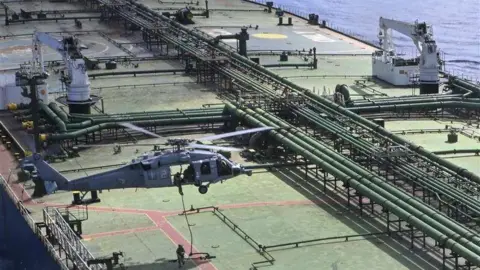
Opening the Strait of Hormuz, the geographic choke point through which 20% of the world's oil export travels, is a 'simple military manoeuvre', but for now only Iranian-approved ships are transiting the waters. The Iranian military is 'gone', but drones and missiles are still striking targets in the region and targets have extended as far as the joint US-UK base in Diego Garcia.
In a Saturday evening post on Truth Social, Trump threatened an escalation, warning that if Iran didn't 'fully open, without threat' Hormuz in 48 hours, the US military would begin targeting Iranian power plants, 'starting with the biggest'.
The day before, however, he had used his social media website to provide a numbered list of American military objectives for the Iran war, which he said the US was 'getting really close' to fulfilling. The items, comprising his most detailed statement on the subject since the war began, included degrading or destroying Iran's military, its defence infrastructure and its nuclear weapons programme, as well as protecting American allies in the region.
Not included was the goal of securing the Strait of Hormuz, which Trump said should be the responsibility of other nations that are more dependent on oil exports from the Gulf. The president has frequently noted that the US is a net exporter of energy and does not rely on oil from the Middle East – although such a view glosses over the global nature of the fossil fuel market, where price fluctuations directly impact the price at American gas pumps.
Trump's latest outline of his objectives raises questions about a potential resolution that leaves Iran’s anti-American leadership intact and its oil exports ongoing. The situation suggests a perilous shift as military analysts speculate that the US may attempt to capture Kharg Island, Iran's primary oil terminal, impacting the nation's economy indefinitely.
As Trump's administration eyes a potential $200 billion request for Congress to fund the conflict, lawmakers express skepticism toward the financial burden and the lack of clarity regarding military goals. The unfolding 'fog of war' serves as an obstacle, both for strategic planning and public perception as the US grapples with the future direction of its involvement in the Iran conflict.