In brief
President Trump has initiated plans to tear down the entire East Wing of the White House to make way for a new ballroom. Despite facing backlash from Democrats and conservation groups, he is leveraging a decades-old exemption from historic preservation laws. This move raises questions about the balance between modernization and the preservation of historical significance within governmental structures.
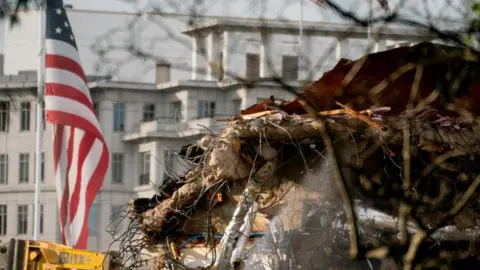
US President Donald Trump plans to knock down the entire existing structure of the White House East Wing to construct a new ballroom - despite previous assurances that the addition would not interfere with the current building.
The sight of demolitions has sparked an uproar from Democrats as well as conservation groups, including the National Trust for Historic Preservation, which wrote a letter calling on Trump to hold a public review process.
As a former property developer, Trump has extensive experience of navigating planning restrictions, and has occasionally found himself on a collision course with campaigners objecting to his plans.
Under a nearly-60-year-old law, the White House and several other notable buildings are exempt from a key historic preservation rule - though one expert told the BBC that presidents typically follow it anyway.
Trump's renovation appears to be the biggest in decades, but the president of the US does have the power to make those changes.
He is not the first to reconstruct the White House. Over the years, a host of presidents have made renovations, from a bowling alley to an indoor swimming pool.
Under a law known as National Historic Preservation Act, federal agencies are required to examine the impact of any construction projects on historic properties. Specifically, Section 106 requires the agencies to undergo a review process, including getting input from the public.
According to Section 107 of the act, three buildings and their grounds are exempt from the Section 106 review process: the White House, the US Capitol and the US Supreme Court building.
In the past, however, typically presidents have voluntarily submitted their plans to the National Capital Planning Commission - which oversees federal building construction - before the construction project begins. Trump officials have not yet done so, but say they plan to, though the renovation has already begun.
Priya Jain, the chair of a heritage preservation committee at the Society of Architectural Historians, told the BBC that the process laid out by the National Historic Preservation Act of 1966 was well established and would have been the best practice for Trump's East Wing renovation.
She further emphasized the importance of maintaining the historical integrity of structures; stating that modifications to the East Wing could impact the narrative of the White House and how it reflects the nation's history.