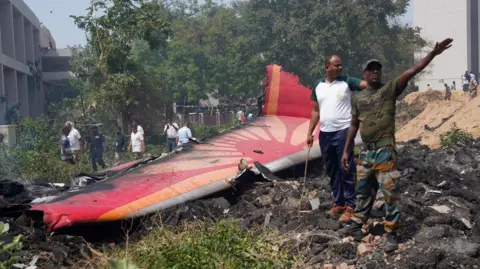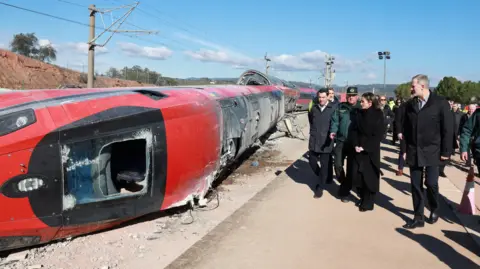
Sunday's high-speed train crash in southern Spain, the worst in over a decade, has been a devastating tragedy for the country, with the loss of at least 42 lives. Amid the grief, many are asking what could have caused such a failure on one of Europe's most admired rail systems. The CIAF rail investigatory commission has started analysing why a train travelling north from Málaga was derailed on a straight section of the route, causing it to collide with an oncoming train, which was also derailed. The Spanish government has described the accident as extremely strange. Three bodies already located in the wreckage were recovered on Tuesday afternoon, and a 42nd victim was also found at the crash site near Adamuz. The shock felt in this sleepy town has been compounded by confusion at how a rail route that ran efficiently for so long suddenly failed.
After its inauguration in 1992, Spain's high-speed rail, or AVE, network was seen as a symbol of the country's modernisation. Built with EU funds, it provided a state-of-the-art transport system that was fast, efficient and safe. A derailment near Santiago de Compostela in 2013 that killed 80 people was not part of the AVE network, although that train was travelling at high speed. Sunday's collision, however, took place on the oldest AVE route, that which connects Madrid with Andalusia.
Several officials, including the president of Renfe, the national rail operator, Álvaro Fernández Heredia, said that human error was almost certainly not the cause of the accident, given that neither train was travelling at an excessive speed. Interior Minister Fernando Grande-Marlaska insisted that sabotage was not a possible cause. Investigators are looking closely at the train that derailed. Owned by Italian firm Iryo, it was manufactured in 2022. Transport Minister Óscar Puente said that carriage number six of the train was going to be examined closely, as it was the first to derail and it offered many pieces of the puzzle.
Part of the track at the crash site was broken, raising speculation about its role in the accident. The government urged caution in drawing conclusions, suggesting the track may have been damaged during the collision. Observers have cited findings from Adif, the rail infrastructure administrator, which highlighted eight technical issues on the line in social media posts over the past year, mainly concerning signalling, some of which were even discussed in the Senate last summer.
In response to safety concerns post-accident, Adif reduced the speed limit on a major section of the AVE network between Madrid and Barcelona. Complaints about the AVE system's comfort and reliability had been logged, prompting calls for infrastructure improvements. Despite the government's claims of recent investment in the rail network, observers remain skeptical about the long-term safety and future of Spain's famed high-speed rail.
Prime Minister Pedro Sánchez promised transparency in the investigation into the crash, declaring three days of mourning as the nation seeks answers and reflects on the tragic loss.
After its inauguration in 1992, Spain's high-speed rail, or AVE, network was seen as a symbol of the country's modernisation. Built with EU funds, it provided a state-of-the-art transport system that was fast, efficient and safe. A derailment near Santiago de Compostela in 2013 that killed 80 people was not part of the AVE network, although that train was travelling at high speed. Sunday's collision, however, took place on the oldest AVE route, that which connects Madrid with Andalusia.
Several officials, including the president of Renfe, the national rail operator, Álvaro Fernández Heredia, said that human error was almost certainly not the cause of the accident, given that neither train was travelling at an excessive speed. Interior Minister Fernando Grande-Marlaska insisted that sabotage was not a possible cause. Investigators are looking closely at the train that derailed. Owned by Italian firm Iryo, it was manufactured in 2022. Transport Minister Óscar Puente said that carriage number six of the train was going to be examined closely, as it was the first to derail and it offered many pieces of the puzzle.
Part of the track at the crash site was broken, raising speculation about its role in the accident. The government urged caution in drawing conclusions, suggesting the track may have been damaged during the collision. Observers have cited findings from Adif, the rail infrastructure administrator, which highlighted eight technical issues on the line in social media posts over the past year, mainly concerning signalling, some of which were even discussed in the Senate last summer.
In response to safety concerns post-accident, Adif reduced the speed limit on a major section of the AVE network between Madrid and Barcelona. Complaints about the AVE system's comfort and reliability had been logged, prompting calls for infrastructure improvements. Despite the government's claims of recent investment in the rail network, observers remain skeptical about the long-term safety and future of Spain's famed high-speed rail.
Prime Minister Pedro Sánchez promised transparency in the investigation into the crash, declaring three days of mourning as the nation seeks answers and reflects on the tragic loss.