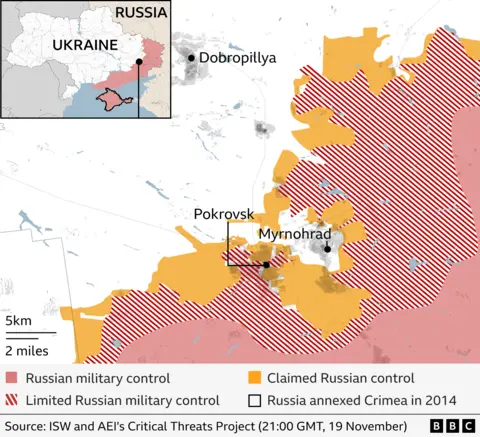
In the dead of night, a Ukrainian soldier whispers into the radio, The toy is delivered. The toy in question is an unmanned ground vehicle (UGV), which has become a lifeline for troops stationed at the frontline in Pokrovsk and Myrnograd, critical locations in eastern Ukraine's ongoing conflict.
The region is under constant threat from Russian forces, who are actively trying to sever Ukraine's supply routes. Without access to essential provisions, Ukrainian soldiers face grim choices—surrender or a costly retreat.
Conventional methods of supplying troops have become too dangerous, as Russia maintains tight control over routes into the city. Transporting supplies on foot presents a considerable risk, thus necessitating the innovative use of UGVs, which serve to deliver supplies and evacuate the wounded.
The battlefield dynamics are evolving, with the Pokrovsk conflict becoming a notable historical instance of large-scale UGV deployment for logistical support in active combat zones. The UGVs, resembling small, turretless tanks, can navigate tight spaces and afford soldiers an operational advantage by being remotely controlled from safer distances.
Approximately 90% of supplies to the frontline are now delivered using these robots. As troops receive urgent reinforcement from Kyiv, the reliance on unmanned systems intensifies due to the high risks associated with traditional troop movements.
Despite the increased use of UGVs, they are not without vulnerabilities. Operators frequently face the threat of drone attacks, and on average, only one in three vehicles successfully reaches its destination. Yet, for the Ukrainian soldiers on the frontline, the robots that do make it are indispensable.
The 5th brigade utilizes a UGV named Termit, capable of carrying around 200kg of supplies, which is crucial for maintaining operational readiness in what has been dubbed the kill-zone. Here, any movement—be it a soldier or a vehicle—can be quickly detected and attacked.
This precarious situation has forced changes in tactics and supply chains on the battlefield, illustrating how technology is reshaping warfare and enabling strategic adaptations that save lives.