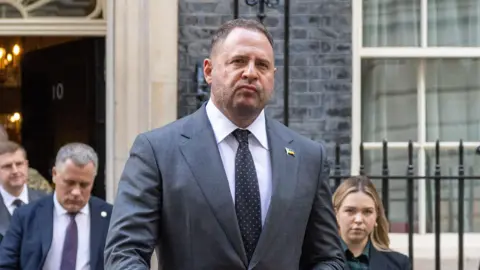
Andriy Yermak was a constant, looming presence in Ukraine's government - a seemingly immovable figure on the political stage. Despite his towering frame, you might not always have spotted him. Yet, wherever President Volodymyr Zelensky was, Yermak was often not far away.
As his chief of staff, Yermak wielded enormous power at the top of government and was even trusted to negotiate on Ukraine's behalf at peace talks with the US. But as his influence grew, so did public resentment of the power wielded by this unelected official. His political career came to an abrupt end on Friday, hours after anti-corruption investigators raided his home in Kyiv.
Yermak and Zelensky first met in 2011 when the former was an intellectual property lawyer and the latter a TV producer. After working together during the successful presidential campaign of 2019, Yermak became Zelensky's chief of staff. He stood next to the president as he gave his now famous we are still here speech as the Russians descended on Kyiv at the start of their full-scale invasion in February 2022.
Despite the favourable conditions Yermak enjoyed within the sprawling Presidential Office, the same couldn't be said outside its steep walls. His popularity was nosediving. In July 2025, President Zelensky attempted to reduce anti-corruption bodies' independence, which led to public outcry and mass protests against the government. As public anger swelled, the National Anti-Corruption Bureau (Nabu) uncovered serious allegations against high-ranking officials, including accusations of siphoning $100 million from public projects.
This backdrop of corruption, coupled with the ongoing conflict and deteriorating conditions for the Ukrainian populace, led to Yermak's resignation. His departure could signal a much-needed reboot for the government, or it may precipitate further instability as Ukraine navigates a challenging path ahead in its fight against corruption and for survival in war.
Yermak's resignation could be seen as a sign of positive change, with hopes that it reflects a strengthening of democratic principles and accountability in Ukraine, especially as the country is currently fortified by the support of allies and demands for governance rooted in transparency.