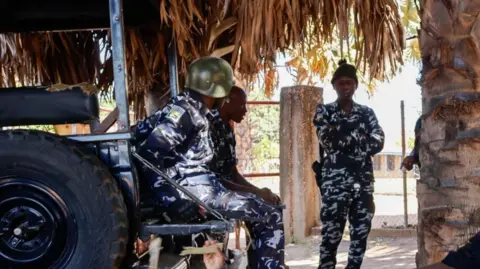
A court in Nigeria has found separatist leader Nnamdi Kanu guilty of terrorism following a decade-long legal case full of drama.
The court stated it was satisfied that Kanu had made a series of broadcasts to incite violence and killings as part of his campaign for a separate state in south-east Nigeria, known as Biafra.
Kanu has been convicted on all seven charges he faced, including terrorism, treason, and involvement with an outlawed movement.
The court has adjourned, with the judge expected to hand down a sentencing later on Thursday. Kanu could face the death penalty, although this is rarely carried out in Nigeria.
Kanu has always denied the charges, and has challenged the court's jurisdiction to put him on trial.
Once a relatively obscure figure, he rose to national prominence in 2009 when he started Radio Biafra, a station that called for an independent state for the Igbo people, broadcasting from London.
In 2014, he founded the Indigenous People Of Biafra (IPOB), a movement advocating for independence for the region. IPOB was banned as a terrorist organization in 2017. Its armed wing, the Eastern Security Network, has been accused of numerous violent acts in recent years.
Judge James Omotosho declared during the verdict that Kanu was 'bent on carrying out these threats without consideration to his own people.' Reaction to the verdict in southeastern Nigeria has been muted, reflecting the complex sentiments surrounding the Biafran cause.
Kanu's legal troubles have been extensive; he was first arrested in October 2015 but jumped bail in 2017 following a military raid on his home. In 2022, a court ordered his charges dropped, stating he was illegally arrested abroad, but this ruling was later overturned by Nigeria's Supreme Court.
The calls for Biafran independence date back many years, with the region's leaders declaring a Biafran state in 1967, which led to a brutal civil war. Although sentiments for independence persist, the actual support for secession among the Igbo populace remains uncertain.