In brief
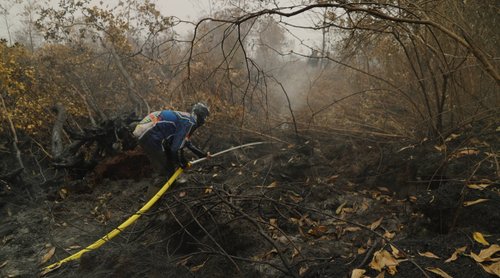
Firefighters face challenging conditions as they work to control wildfires in Nebraska, which have burned over 1,300 square miles and resulted in one fatality. Governor Jim Pillen and officials remain cautiously optimistic about containment efforts, as strong winds and dry conditions threaten to exacerbate the situation ahead of potential heat waves later this week. The agricultural impact on local ranchers is expected to be significant as recovery from the fires will take years.
A coalition of firefighters and volunteers entered their seventh day Wednesday of battling wildfires in western and central Nebraska — including one that is the largest in state history — that have scorched a massive area of range and grassland and killed one person.
“What’s different today is the wind will be less — still, with gusts to 30 miles an hour — but we’re starting to dry out and heat up again,” said David Boyd, a spokesman for the coalition of state, federal, and local officials overseeing the effort. “If we get fire, you know, across the containment line, it’s got the potential for rapid spread.”
Nebraska Gov. Jim Pillen’s assessment was more succinct.
“We are making progress, but the fight isn’t over,” Pillen said in a Facebook post on Wednesday while touring the area.
Four separate fires have burned around 1,300 square miles (about 3,367 square kilometers) — larger than Rhode Island. The largest of the fires, dubbed the Morrill County fire, covers parts of five counties and stretches more than 80 miles (129 kilometers) from around Bridgeport in the Nebraska Panhandle east to Lake Ogallala. It has burned about 1,005 square miles (about 2,603 square kilometers), making it the largest wildfire in Nebraska history.
Strong winds gusting over 60 mph (97 kph) starting last week have sent the fires roaring over the region’s rolling hills, fueled by tinder-dry prairie grass and stands of red cedar. The fires remained uncontained for days until Tuesday, when the winds slowed, and some rain and snow allowed firefighters to get a handle on the flames. Even so, the Morrill County fire remained only 16% contained by midday Wednesday.
The second-largest blaze, called the Cottonwood fire, has burned more than 205 square miles (about 531 square kilometers), starting about 10 miles (16 kilometers) southeast of North Platte. It was about 40% contained by Wednesday, according to Boyd.
At least one person -- an 86-year-old woman from rural Arthur -- died at her home trying to escape the fire. Dozens of structures have burned. At least one residential area near Jeffrey Reservoir, around the Cottonwood fire, has been evacuated since last weekend. “That area is forested with red cedar, and so that holds fire more,” Boyd explained. “We actually have hand crews in there that are cutting fire line in with chainsaws, you know, pretty close to the edge of what was burning.”
Also concerning is how cattle ranchers will deal with the fallout of the fires in the months and years to come. The Morrill County fire area alone provides grazing for more than 35,000 head of cattle. Agriculture experts anticipate it can take several growing seasons for the land to recover.
Firefighters are cutting trenches around the fires and extinguishing areas still burning within the lines to maintain containment. However, officials warn that Saturday could bring conditions ripe for wildfires with strong winds and record heat anticipated.
The wildfires are part of a chaotic weather week in the region, noted for extreme heat across parts of California and storms that have disrupted travel across the East Coast.