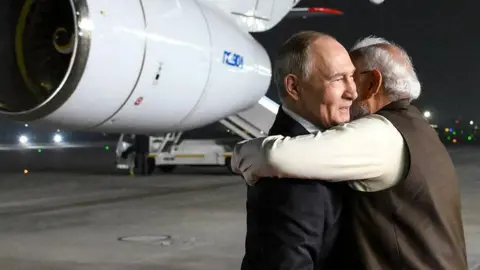
Russian President Vladimir Putin has arrived for a two-day visit to India, where he was embraced by Prime Minister Narendra Modi ahead of an annual summit held by both countries.
Delhi and Moscow are expected to sign a number of deals during the visit, which comes months after the US increased pressure on India to stop buying Russian oil.
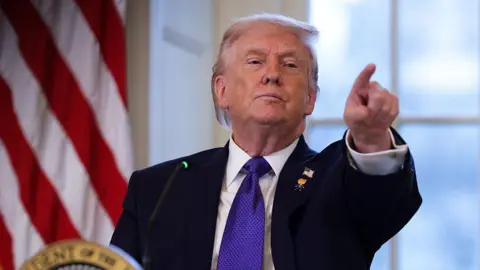
It also comes as US President Donald Trump's administration holds a series of talks with Russia and Ukraine in an attempt to end the war.
India and Russia have been close allies for decades and Putin and Modi share a warm relationship. Here's a look at why they both need each other - and what to watch for as they meet.
A special friendship, trade deals and geopolitics
Why are relations with India key for the Kremlin? Well, for a start, look at the numbers:
- a population of nearly a billion and a half.
- economic growth exceeding 8%. India is the world's fastest growing major economy.
That makes it a hugely attractive market for Russian goods and resources - especially oil.
India is the world's third largest consumer of crude oil and has been buying large volumes from Russia. That wasn't always the case. Before the Kremlin's full-scale invasion of Ukraine, only 2.5% of India's oil imports were Russian.
That figure jumped to 35% as India took advantage of Russian price discounts prompted by sanctions against Moscow and Russia's restricted access to the European market.
India was happy. Washington less so.
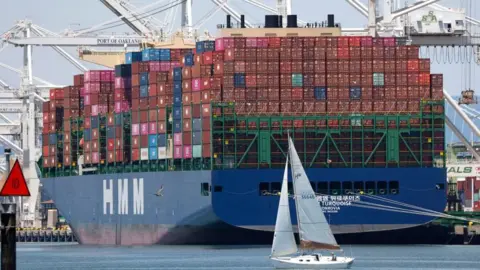
Earlier this year, the Trump administration slapped an additional 25% tariff on Indian goods, arguing that by purchasing oil from Russia, India was helping to fund the Kremlin's war chest. Orders from India for Russian oil have since dropped. President Putin will be keen for India to keep buying.
For Moscow, weapons sales to India are another priority and have been since Soviet times. Ahead of Putin's visit, there were reports that India plans to purchase state-of-the-art Russian fighter jets and air defence systems.
Russia, hit by a labour shortage, also sees India as a valuable source of skilled workers.
But there's geopolitics at play, too.
The Kremlin enjoys demonstrating that Western efforts to isolate it over the war in Ukraine have failed. Flying to India and meeting Prime Minister Modi is one way of doing that.
This week, expect to hear about Russia-India friendship, trade deals, and increased economic cooperation between Moscow and Delhi.
Test of Modi's strategic autonomy
Putin's visit to Delhi is coming at a crucial time for Modi and India's global ambitions. India-Russia ties go back to the Soviet era and have endured irrespective of the changing geopolitical landscape. Putin has arguably put more time and energy into this relationship than other Russian leaders before him.
As for Modi, despite coming under intense pressure from Western governments to criticise Russia over its war in Ukraine, he maintained that dialogue was the only way to resolve the conflict.
In this context, Putin's visit assumes more significance for Modi than ever before because it will test India's geopolitical autonomy. He will be walking the proverbial diplomatic tightrope here.
Modi would want to show Indians at home and in the wider world that he still counts Putin as his ally and hasn't given into pressure from Trump.
But he has also faced pressure from his allies in Europe. Modi aims to position Indian goods in Russia's market, seeking a balanced approach that benefits both nations. Putin's visit thus represents not just a reunion of friends but a crucial negotiation for the future of their bilateral relationship.