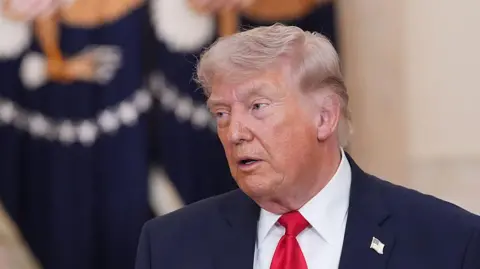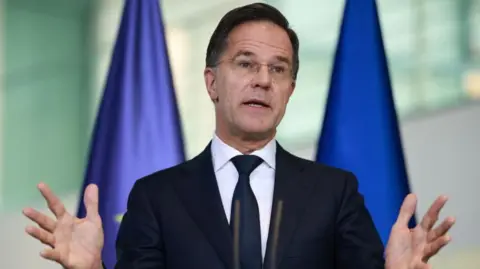
NATO countries' pledge to spend 5% of their economic output on defence is Donald Trump's 'biggest foreign policy success,' the alliance's chief has said. In an interview with the BBC, Mark Rutte said it was thanks to Donald Trump that NATO was 'stronger than it ever was', adding that Trump 'is good news for collective defence, for NATO and for Ukraine'.
The US leader has harshly criticised European allies for spending very little on defence - even threatening to withdraw US protection if they fail to do so. The NATO chief has warned that Russia could attack allies within the next five years. Russia's President Vladimir Putin dismissed such talk as 'hysteria' on Wednesday.
After Putin launched Russia's full-scale invasion of Ukraine in February 2022, he announced the annexation of four Ukrainian regions - Donetsk, Luhansk, Zaporizhzhia, and Kherson. Russia had already annexed Crimea in 2014. It now occupies most of Luhansk, and is understood to demand Ukraine's withdrawal from all of Donetsk, too, even though Ukraine still controls up to 23% of the eastern region.
Putin said the goals of what he calls 'the special military operation' would be achieved, indicating a preference for diplomacy but also warning that, 'if the opposing side and their foreign patrons refuse to engage in substantive discussions, Russia will achieve the liberation of its historical lands by military means.'
Mark Rutte praised Trump's efforts to find an end to the war. US envoys have been conducting intense negotiations with Ukrainian officials over a Trump-proposed peace plan whose initial draft was seen as favouring Russia, envisaging ceding control of territory in the east of the country to Russia while offering security guarantees for Kyiv.
Rutte stated, 'Now we are stronger, but if we do not implement the Hague decisions, we would be weaker than the Russians in a couple of years and that is extremely dangerous.'
NATO, which includes 30 European countries alongside Canada and the US, pledged during their summit in The Hague in June to increase military spending to 5% of their gross domestic product by 2035, citing the 'long-term threat posed by Russia' and terrorism, among other factors. Rutte maintained that this commitment is crucial to counter potential aggressions from Russia.