In brief
James Watson, the renowned scientist known for his discovery of the DNA double helix, has passed away at the age of 97. His contributions to molecular biology are monumental, yet his legacy is tainted by contentious views on race and gender which led to his isolation from the scientific community. Despite his Nobel Prize-winning achievements, Watson's later years were overshadowed by his controversial public statements and ensuing backlash.
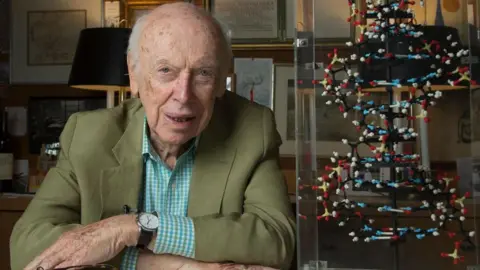
Nobel Prize-winning American scientist James Watson, one of the co-discoverers of the structure of DNA, has died aged 97.
In one of the greatest breakthroughs of the 20th Century, he identified the double-helix structure of DNA in 1953 alongside British scientist Francis Crick, setting the stage for rapid advances in molecular biology.
However, Watson's reputation was marred by comments he made regarding race and intelligence. In a television interview, he controversially suggested that genetic differences contributed to variations in average IQ between different racial groups.
His death was confirmed by Cold Spring Harbor Laboratory, where he had worked and researched for decades until he was forced to resign as its chancellor due to his comments.
Watson shared the Nobel Prize in Physiology or Medicine in 1962 with Maurice Wilkins and Francis Crick for the discovery of DNA's double helix. We have discovered the secret of life, they declared at the time.
By the early 2000s, Watson was largely ostracized by the scientific community due to his controversial remarks regarding race and uplift in intelligence metrics.
In a 2007 interview, he expressed his pessimism about intelligence levels and social policies in Africa, leading to increased backlash and his dismissal from Cold Spring Harbor Laboratory.
DNA was first discovered in 1869, but the structure remained a mystery until Watson and Crick used X-ray diffraction images, including those taken by Rosalind Franklin, to construct a physical model of DNA.
Despite some contributions as a mentor to female scientists, Watson's career became increasingly controversial due to his remarks on women's capabilities in science. In 2014, he made headlines again by selling his Nobel laureate gold medal for $4.8 million, stating he felt shunned by the scientific community.
Born in Chicago in April 1928, Watson displayed an early interest in biology and went on to study at the University of Chicago before moving to Cambridge University where his collaboration with Crick led to their historic discovery.
Watson remained a polarizing figure, admired for his scientific genius but criticized for his views, solidifying his complex legacy as both a revolutionary scientist and a controversial public figure.