In brief
A team of international scientists is making strides in uncovering ancient scrolls, previously thought lost forever, with innovative digital methods yielding promising results.
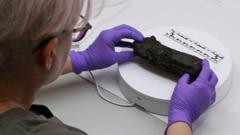
In a groundbreaking achievement, researchers have revealed insights from a 2,000-year-old scroll charred by the volcanic eruption of Mount Vesuvius in 79 AD. This charred artifact, discovered in the Roman town of Herculaneum, was too fragile for physical handling, resembling a piece of charcoal. However, a combination of cutting-edge X-ray imaging techniques and artificial intelligence has allowed scientists to virtually "unroll" the scroll, unveiling its hidden text for the first time in two millennia.Project lead Stephen Parsons of the Vesuvius Challenge, an international initiative aimed at deciphering the Herculaneum scrolls, shared optimism about the results. "We are confident we will be able to read the entire scroll," he stated, highlighting the significance of this breakthrough. The team has already discerned visible letters, suggesting the text could center around philosophical themes.Centuries ago, Herculaneum's inhabitants faced the same fate as those in nearby Pompeii when ash and debris from the volcanic eruption consumed their town. Hundreds of carbonized scrolls were retrieved from Herculaneum but remained untouched due to the risk of damage. The University of Oxford's Bodleian Library houses some of these precious scrolls, previously deemed beyond readable condition. Nicole Gilroy, head of book conservation, elaborated on the risks associated with traditional methods. "We were unsure if prior techniques would safely and effectively yield any valuable information," she explained. The advancement of high-tech methodologies prompted a reevaluation, allowing the team to extract one scroll from the library's storage.The scroll underwent examination at the Diamond Light Source in Oxfordshire, where powerful X-ray beams, generated by accelerated electrons, penetrated the fragile manuscript safely. Adrian Mancuso, director of physical sciences at Diamond, emphasized the precision of the scans, which can reveal details at a microscopic level.Following the X-ray scans, AI technology is employed to identify the ink on the papyrus, a complex task given that both substances are carbon-based and nearly indistinguishable. The AI algorithm meticulously searches for subtle signals indicating the presence of ink, digitally "painting" the text back to life.Parsons expressed excitement about the project’s advancements, stating, "We can confirm that the entire scroll contains text." Future work aims to enhance visibility, transitioning from isolated words to substantial passages of ancient thought. Last year, a Vesuvius Challenge team successfully interpreted about 5% of another scroll, delving into Greek Epicurean philosophy, which posits that satisfaction can be found through life's simple pleasures.With the likelihood that the Bodleian scroll covers similar philosophical topics, the Vesuvius team emphasizes the need for a blend of human expertise and computational power to reveal more of its secrets. As Gilroy reflects on the project's significance, she notes, "There's a genuine human connection to those who authored these texts, a precious link to our past."