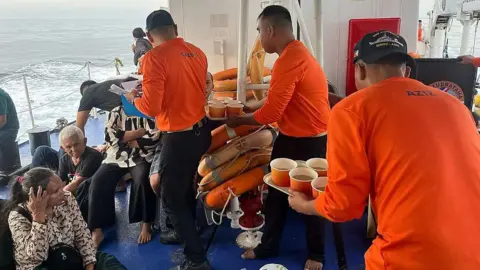
Hundreds of aftershocks jolt Philippines as officials say death toll could rise
A magnitude 7.8 earthquake struck the southern Philippines on Monday, leaving 37 dead and 487 injured. Hundreds of aftershocks continue to shake the region, broadening the emergency response.
The devastation on Mindanao is stark: collapsed buildings, cracked roads, and landslides burying highways. Large swathes still lack electricity and telephone connectivity.
The quake triggered tsunami warnings in Indonesia, South of Mindanao, and across Japan’s Pacific coast, displacing thousands. Emergency crews search for survivors while treating the wounded, with some still experiencing strong aftershocks.
“We hope the death toll does not increase further, but we expect it to move,” Assistant Secretary Bernardo Alejandro said on DZMM. His agency estimates 2,000 homes and 6,000 schools damaged.
Mindanao sits on the Pacific Ring of Fire, where tectonic activity is frequent. The Cotabato Trench off the country’s southern tip produced this quake. That trench caused a 7.9‑magnitude quake in 1976 that triggered a deadly tsunami.
In Polomolok town, construction worker Ramel Pato was bringing his children to school when the ground rattled, leaving students running and screaming. Teacher Cesar Sundo described a two‑minute “rocking like a hammock” and the shaking growing stronger every second.
Sundo credited the school’s morning assembly for keeping students safe; many were outside and remained stationary. Seismologist Renato Solidum noted this as one of the region’s strongest quakes.
A viral clip of a Jollibee restaurant collapsing in General Santos City made headlines. The chain confirmed all staff in affected areas were safe.
President Ferdinand Marcos Jr. mobilised the entire government to respond, with transportation and health officials flying to Mindanao. Health Secretary Teodoro Herbosa warned that even while treating the injured, aftershocks were still striking.
Access remains difficult for towns like Jose Abad Santos in Davao Occidental, where landslides block half the highway. Resupply must come by air to reach far‑flung barangays.