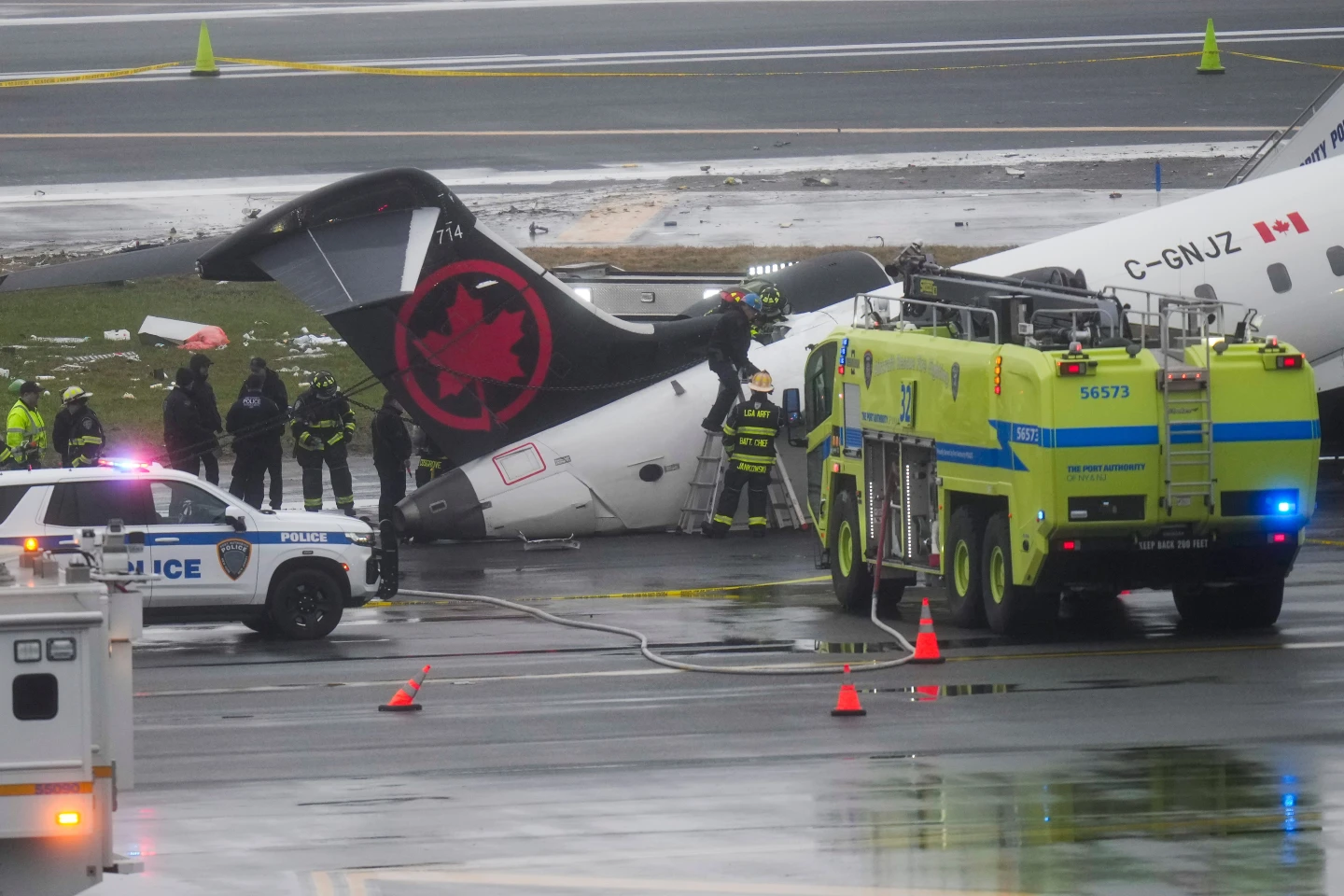
Federal investigators on Thursday detailed a series of issues and failures that led up to the recent deadly collision between a regional jet and a fire truck at New York's LaGuardia Airport.
According to a preliminary report from the National Transportation Safety Board (NTSB), the fire truck drove through a stop signal at the airport and lacked a transponder necessary for a crash warning system. During the incident, air traffic was heavily congested due to delays and an emergency regarding another flight.
Air Canada Express Flight 8646, arriving from Montreal with 76 people on board, collided with the truck shortly after landing on March 22. Pilots Antoine Forest, 30, and Mackenzie Gunther, 24, tragically lost their lives, and 39 passengers sustained injuries, along with two personnel in the fire truck.
This marked the first fatal crash at LaGuardia in 34 years.
Busy Air Traffic Controllers
On the night of the accident, two air traffic controllers were on duty, which is standard. However, the airport faced unprecedented traffic pressure due to delays, more than doubling the number of scheduled arrivals and departures after 10 p.m. Additionally, the controllers were managing an emergency situation involving a departure, significantly increasing their workload.
No Transponder on the Fire Truck
The fire truck involved was not equipped with a transponder, which would allow the airport's advanced surveillance system to accurately track its location. This lack of equipment contributed to confusion in the air traffic controls, leading to the collision.
Failure of Warning Systems
Automated warning systems designed to manage cross-traffic were rendered ineffective as red lights warning of oncoming aircrafts were ignored. The fire truck had been cleared for crossing without consideration of these signals, despite their indication that a landing aircraft was imminent.
Urgent Calls to Stop
As the collision was about to happen, air traffic control urgently instructed the fire crew to halt their approach. However, due to communication challenges and the high-speed nature of the fire truck, it did not stop in time.
The investigation highlights the critical importance of effective communication and technology integration to ensure safety in high-traffic airport settings.