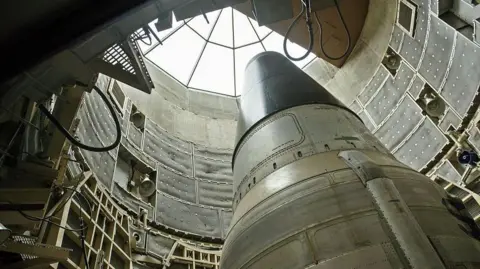
The last nuclear weapons control treaty between the US and Russia is due to expire on Thursday, raising fears of a new arms race.
The Strategic Arms Reduction Treaty, known as New START and signed in 2010, was designed to prevent catastrophic nuclear war.
The treaty capped the number of deployed strategic nuclear warheads for each party to 1,550, alongside transparency measures like data sharing and on-site inspections.
Its expiry marks an end to arms control cooperation that helped end the Cold War.
Pope Leo urged both nations to renew the treaty, highlighting the need for efforts to avert a new arms race amidst current global tensions.
The original START treaty, signed in 1991, limited the two signatories to 6,000 nuclear warheads, succeeded by New START.
Despite a suspension three years ago, both countries observed the treaty rules, which prevented unchecked nuclear buildup and mitigated mutual misjudgments.
The treaty's expiration follows a troubling trend, with notable arms control agreements dissolving, including:
- The Intermediate-Range Nuclear Forces Agreement, eliminating short-range nuclear weapons in Europe.
- The Open Skies Treaty, which permitted unarmed reconnaissance flights over territories.
- The Conventional Armed Forces in Europe Treaty, limiting troop and artillery deployment in Europe.
Admiral Sir Tony Radakin, a former British armed forces head, expressed concerns over the unraveling frameworks that maintained global safety, describing the collapse of these treaties as a significant security risk.
Dmitry Medvedev, Russia's former president, warned that the treaty's expiration should concern everyone, especially considering his previous nuclear rhetoric, while former US President Donald Trump downplayed the risk, suggesting a better agreement could be reached post-expiration.
Currently, both countries are enhancing their nuclear capabilities, with experts pointing out the growing likelihood of an arms race fuelled by advancements in hypersonic missile technology.
As Darya Dolzikova from the RUSI pointed out, the expiration of New START creates a worrying landscape where both nations appear motivated to expand their strategic arsenals, complicating future arms control discussions.
Each nation’s developments signal an increasingly volatile period ahead, emphasizing the urgent need for renewed dialogue on nuclear disarmament and safety.