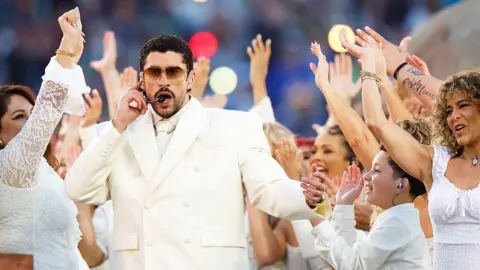
Bad Bunny's Super Bowl half-time show was one big love letter to his native Puerto Rico. The 14-minute set included guest performances from Lady Gaga and Ricky Martin, along with cameos from the likes of Pedro Pascal, Cardi B, Karol G, and Jessica Alba, who could be seen dancing on the porch of his famous casita, a staple of his shows designed to look like a traditional Puerto Rican home.
It was expected that Bad Bunny, real name Benito Antonio Martinez Ocasio, would use his performance as an opportunity to make a political statement against the current US administration, but instead he used it to promote a message of American unity. Transporting himself through a Latin landscape, with set pieces that included everything from a nail salon to a bar, the Grammy award winner reeled off a medley of his biggest hits, including Tití Me Preguntó, MONACO and BAILE INoLVIDABLE.
The 31-year-old, who was the world's most-played artist in 2025 according to streaming service Spotify, made history by becoming the first musician to perform a Super Bowl half-time show entirely in Spanish. But he did choose to make two statements in English, one with a billboard message reading The only thing more powerful than hate is love and the other Together, We Are America written on a football that he held.
His performance at Levi's Stadium in Santa Clara marked the first time the singer and rapper has performed in the USA since releasing last year's Grammy-award winning album Debí Tirar Más Fotos (I Should Have Taken More Photos). Puerto Rico was at the heart of everything in this performance, from his early emergence from a sugarcane field to a set that was meant to represent the sounds and sights of the place he calls home.
Family also featured heavily - from a young couple getting married in a crowd full of Latino dancers to the symbolic moment of Bad Bunny handing his Grammy award to a small child as his 2026 acceptance speech played on a small television. Climbing an electricity pylon - symbolising the infrastructure that was ruined during the devastating storm - and rapping at the same time, he appeared to pay tribute to the people who died in the 2017 Hurricane Maria.
Bad Bunny further spread a message with his outfit - wearing a beige sweater emblazoned with the number 64. It could represent the official death toll, which turned out to be significantly lower than the estimated thousands who died. President Trump's administration was criticised at the time by Puerto Ricans who said it failed to provide the same federal support compared to hurricanes that had occurred on the mainland.
Their actions have prompted protests in multiple US cities - most recently in Minneapolis, where federal agents shot and killed two Americans, leading to scrutiny of the administration's tactics. In his Grammy acceptance speech after his win for best musicá urbana album, Bad Bunny called for ICE out, urging a fight against hate with love.
President Trump called Bad Bunny's Super Bowl set absolutely terrible, one of the worst, EVER! on his social media platform Truth Social, adding that it was an affront to the Greatness of America.
Sunday's show represented the best of Latin culture on the sporting world's biggest stage, blending messages of love, family, and tribute to Puerto Rico with high-energy performances and celebrity guest appearances.
It was expected that Bad Bunny, real name Benito Antonio Martinez Ocasio, would use his performance as an opportunity to make a political statement against the current US administration, but instead he used it to promote a message of American unity. Transporting himself through a Latin landscape, with set pieces that included everything from a nail salon to a bar, the Grammy award winner reeled off a medley of his biggest hits, including Tití Me Preguntó, MONACO and BAILE INoLVIDABLE.
The 31-year-old, who was the world's most-played artist in 2025 according to streaming service Spotify, made history by becoming the first musician to perform a Super Bowl half-time show entirely in Spanish. But he did choose to make two statements in English, one with a billboard message reading The only thing more powerful than hate is love and the other Together, We Are America written on a football that he held.
His performance at Levi's Stadium in Santa Clara marked the first time the singer and rapper has performed in the USA since releasing last year's Grammy-award winning album Debí Tirar Más Fotos (I Should Have Taken More Photos). Puerto Rico was at the heart of everything in this performance, from his early emergence from a sugarcane field to a set that was meant to represent the sounds and sights of the place he calls home.
Family also featured heavily - from a young couple getting married in a crowd full of Latino dancers to the symbolic moment of Bad Bunny handing his Grammy award to a small child as his 2026 acceptance speech played on a small television. Climbing an electricity pylon - symbolising the infrastructure that was ruined during the devastating storm - and rapping at the same time, he appeared to pay tribute to the people who died in the 2017 Hurricane Maria.
Bad Bunny further spread a message with his outfit - wearing a beige sweater emblazoned with the number 64. It could represent the official death toll, which turned out to be significantly lower than the estimated thousands who died. President Trump's administration was criticised at the time by Puerto Ricans who said it failed to provide the same federal support compared to hurricanes that had occurred on the mainland.
Their actions have prompted protests in multiple US cities - most recently in Minneapolis, where federal agents shot and killed two Americans, leading to scrutiny of the administration's tactics. In his Grammy acceptance speech after his win for best musicá urbana album, Bad Bunny called for ICE out, urging a fight against hate with love.
President Trump called Bad Bunny's Super Bowl set absolutely terrible, one of the worst, EVER! on his social media platform Truth Social, adding that it was an affront to the Greatness of America.
Sunday's show represented the best of Latin culture on the sporting world's biggest stage, blending messages of love, family, and tribute to Puerto Rico with high-energy performances and celebrity guest appearances.