In brief
A newly discovered hand stencil in a cave on Muna, Indonesia, is now considered the oldest known cave painting, dating back 67,800 years. This discovery challenges previously held beliefs about the timeline of human creativity and migration patterns, suggesting that symbolic thought and artistic expression were present in Homo sapiens much earlier than previously thought. The findings support a broader narrative of human creativity across regions, including Australia and New Guinea, predating the conventional focus on Europe.
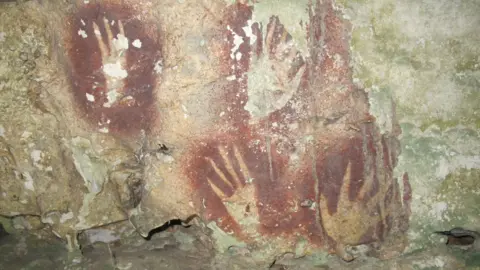
Researchers have identified a stenciled outline of a hand found in the limestone caves of Muna, an island off the southeastern coast of Sulawesi, as the world's oldest-known cave painting. This red outline of a hand, estimated to be at least 67,800 years old, suggests a significant leap in early human symbolic imagination.
This new finding predates the previous record for cave art, which featured a hand stencil in Spain dated around 66,700 years ago. The implications of this discovery extend beyond art history, indicating that our species, Homo sapiens, may have reached the wider Australia–New Guinea region, known as Sahul, approximately 15,000 years earlier than previously accepted timelines.
Over the past decade, discoveries on Sulawesi have reshaped the understanding of when artistic expression and abstract thought emerged among humans, previously thought to have originated during the Ice Age in Europe. Ongoing findings suggest that the capacity for creativity was present as early as when humans migrated out of Africa.
Professor Adam Brumm, co-leader of the research, emphasizes that the emergence of narrative art is no longer viewed as a phenomenon limited to Europe but reflects a broader narrative of human innovation and creativity.
The hand stencil in question was created by an ancient artist pressing their hand against the wall and surrounding it with pigment, leaving a negative imprint. However, the recent analysis further revealed that the fingers of the stencil were deliberately altered to create a claw-like shape, indicating a higher level of creativity that was likely absent in the art produced by Neanderthals around the same period.
In essence, this discovery in Sulawesi not only rewrites the timeline of human creativity but also suggests that the ancestral population of Australia may have included artists who painted these significant images, contributing to the early history of humankind.