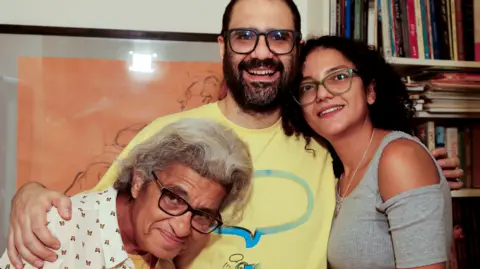
British-Egyptian pro-democracy activist Alaa Abdel Fattah was stopped from flying to the UK by Egyptian passport control earlier this week, his family says.
Mr Abdel Fattah, 43, was Egypt's best known political prisoner until seven weeks ago, when he was released from jail after being granted a pardon by President Abdul Fattah al-Sisi.
He attempted to fly to London on Tuesday with his sister Sanaa, but was told by officials at Cairo International Airport that he was not allowed to travel.
They blocked him from boarding the flight and I had to go alone, Sanaa told the BBC's Today programme on Friday. There was no immediate comment from the Egyptian government.
They didn't explain much. Our lawyers in Egypt are trying to understand the legal grounds, Sanaa said.
She added that her brother had his British passport as well as a recently renewed Egyptian passport.
I assumed after the renewal of the Egyptian passport that he would be allowed.
Alaa Abdel Fattah's 13-year-old son, Khaled, lives with his mother in Brighton, where he attends a special needs school because he is on the autism spectrum.
Khaled spent a month visiting his father in Cairo following his release from prison, but he has now returned to the UK.
We're really glad to have [Alaa] back in our lives partially free, but he needs to have freedom of movement to live with his son, reunited with him properly, Ms Seif said.
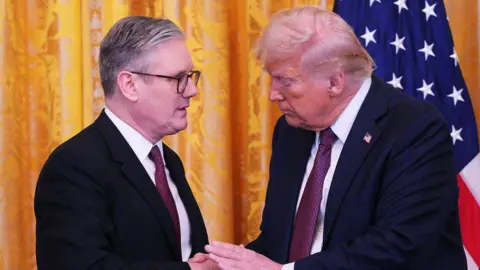
She called on Prime Minister Sir Keir Starmer's office to also give it their attention as the case is a priority issue for the UK government.
On Thursday night, Alaa Abdel Fattah and his mother were given the 2025 Magnitsky Award for Courage Under Fire. Sanaa had to collect the award on their behalf.
Mr Abdel Fattah rose to prominence during the 2011 uprising in Egypt that forced long-time President Hosni Mubarak to resign and has spent most of his time in prison since the military coup in 2014.
His treatment has raised serious concerns internationally regarding human rights abuses in Egypt.