In brief
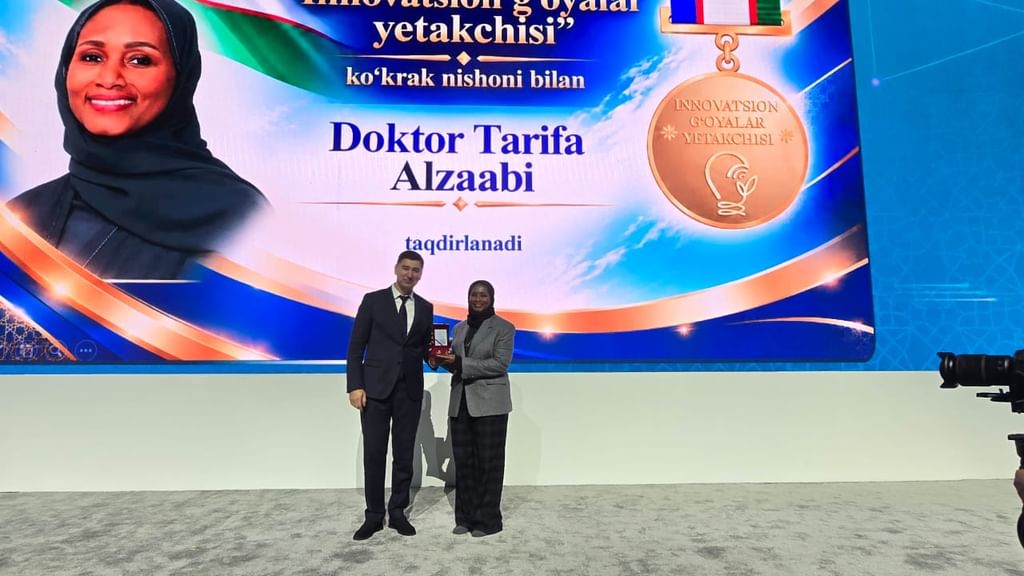
At InnoWeek 2026 in Tashkent, Dr. Tarifa Alzaabi, Director‑General of the International Centre for Biosaline Agriculture, was awarded the “Leader of Innovative Ideas” badge for pioneering projects that convert biosaline research into practical, climate‑resilient farming practices. The accolade highlights ICBA’s Farmers’ and Agro‑Entrepreneurs Accelerator, which empowers Uzbek farmers—especially women and youth—to turn resilient crops into market‑ready products. The recognition underscores the growing collaboration between Emirates and Uzbekistan in sustainable agricultural development.
On 7 November 2026, the International Centre for Biosaline Agriculture (ICBA) celebrated a milestone at the InnoWeek conference in Tashkent, Uzbekistan, when its Director‑General Dr. Tarifa Alzaabi was honoured with the “Leader of Innovative Ideas” badge. The award, granted by the Agency for Innovative Development and the Central Council of the Youth Union of Uzbekistan, recognised the centre’s role in translating specialised biosaline research into viable, climate‑resilient farming solutions on the ground.
ICBA, headquartered in the United Arab Emirates, specialises in producing crops and production systems that thrive in saline and arid environments. Dr. Alzaabi, noted for his work in the region, has directed the centre’s efforts in collaboration with a range of international partners, aiming to boost food security where soils and water are increasingly stressed by climate change.
The InnoWeek 2026 event, organised by the Ministry of Higher Education, Science and Innovation, focuses on innovations that drive sustainable development in Central Asia. The “Leader of Innovative Ideas” badge was created following a resolution by the Cabinet of Ministers of the Republic of Uzbekistan, and has become a symbol for those who advance practical technology that blends science with local development priorities.
Central to the award was the Farmers’ and Agro‑Entrepreneurs Accelerator, a joint initiative between ICBA, the Agency for Innovative Development, and the Abu Dhabi Fund for Development (ADFD). Launched in the remote desert region of Karakalpakstan, the accelerator combines research, financing and local knowledge to help smallholders produce climate‑resilient crops that can be marketed effectively.
Within this framework, field trials of salt‑tolerant barley, chickpea and berseem clover have yielded high‑yield, low‑water‑use varieties that local farmers have begun to cultivate. Participants receive agronomic training, financial guidance and market linkage support, enabling them to transform raw crops into value‑added products across food, feed and bio‑based materials sectors.
Dr. Alzaabi said, “I am proud to receive this recognition and deeply appreciate the efforts of the ICBA team and our partners in Uzbekistan, as well as the support of ADFD in connecting scientific solutions with local development priorities.” He added that ICBA’s responsibility extends from developing crops and production systems suited to arid and saline environments to equipping farmers with the knowledge and skills needed to sustain production and improve livelihoods.
"The accelerator programme brings together development finance, research expertise and local knowledge. Participants are transforming crops into products that meet market needs, expanding income opportunities and strengthening the participation of women and young people in the agricultural economy," Dr. Alzaabi added.
The focus on women and youth participation has opened pathways for empowered agrarian communities. Many women farmers in Karakalpakstan, traditionally limited by market access, now report new income streams from processed products such as dried seed cakes and specialty grains. Youth involvement, driven by mobile‑based agritech platforms initiated through the programme, has increased innovation adoption and reduced desert‑related migration.
The award also reflects the broader impact of Emirati women leaders in research institutions. Dr. Alzaabi highlighted how the UAE’s emphasis on education, professional development and inclusive leadership has enabled Emirati women to apply their expertise in addressing community challenges and advancing international collaboration.
For sustainable agriculture in degraded regions, the partnership between ICBA and Uzbekistan offers a blueprint where science, finance and community drive food system resilience. The InnoWeek recognition underscores the importance of translating research into market‑ready technologies that enhance livelihoods while safeguarding ecosystems. As climate change continues to threaten fragile agricultural landscapes, such innovations demonstrate how international cooperation can turn vulnerability into opportunity for local communities.