In brief
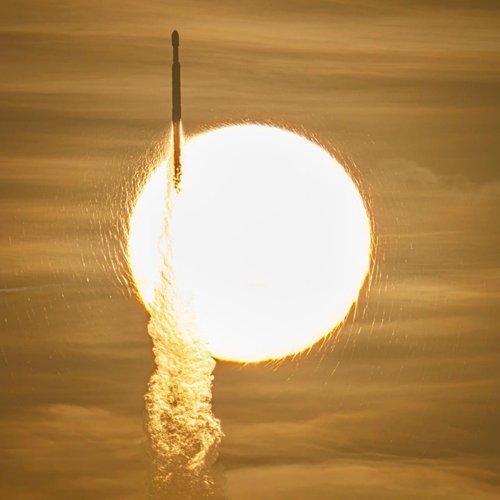
NASA has successfully launched the Europa Clipper spacecraft from Cape Canaveral, Florida, setting its sights on Jupiter’s enigmatic moon, Europa. Scheduled to arrive in 2030, the mission aims to probe for signs of life beneath Europa's ice-covered surface, potentially doubling Earth’s water resources.
After weather delays due to Hurricane Milton, NASA's ambitious mission Europa Clipper has taken off. The spacecraft is designed to explore Europa, one of Jupiter’s intriguing moons, where scientists believe a hidden ocean slumbers under thick ice. This $4.25 billion mission represents a groundbreaking leap in our quest to understand potential life beyond Earth. Hoping to unveil the moon’s mysterious icy shell, Clipper is equipped to penetrate its surface with sophisticated instruments developed at NASA's Jet Propulsion Laboratory. Scientists speculate Europa’s ocean, detected by prior missions and telescopic observations, could harbor the basic ingredients necessary for life, challenging our understanding of where and how life could exist in the universe.This mission's potential impact on space exploration is immense. If Clipper uncovers signs of life, it would suggest that life might independently originate in similar extraterrestrial environments, reshaping our cosmic perspective. Such a discovery would mean far more than academic knowledge; it would redefine our existential viewpoint, emphasizing the vast possibilities of life across the cosmos. Powered by the gravitational forces of Earth and Mars, Europa Clipper is set for an epic five-and-a-half-year journey. The spacecraft, swinging past the two planets for momentum, will eventually settle into orbit around Jupiter, conducting about 50 flybys of Europa. This endeavor acknowledges the scientific community's cautious optimism, focusing on whether Europa might support life rather than finding human-like creatures.Collaborating with entities like the Jet Propulsion Lab and Johns Hopkins Applied Physics Lab, NASA aims to uncover Europa's secrets and lay the groundwork for future missions. This exploration signifies humanity’s unyielding curiosity and ambition to extend our reach across the stars, breaking new ground in our understanding of life’s expanses in the universe.