In brief
In the wake of ongoing conflict in Gaza, healthcare is collapsing as doctors, like Dr. Wissam Sukkar, face overwhelming challenges. With limited resources and a rise in malnutrition and disease among displaced populations, she recounts her daily struggles to care for patients while grappling with her own family's dire situation.
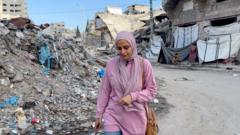
Dr. Wissam Sukkar, a determined GP working for Médecins Sans Frontières (MSF), begins her day navigating the war-ravaged streets of Gaza City, where healthcare has become severely compromised. She recounts a lengthy trek to the clinic, stating, “I was walking for around 50 minutes to reach our clinic,” reflecting the dire transportation issues in the region compounded by an ongoing fuel shortage.As she arrives, the surge of patients is overwhelming; already 150 individuals are waiting outside by the time she dons her white coat. With only 21 of Gaza’s 36 hospitals currently operational, the healthcare situation in the region is grim. Dr. Sukkar notes, "Most of our patients are displaced people," many residing in makeshift shelters or tents, which exacerbates health problems like malnutrition and communicable diseases among the vulnerable.With a ceasefire broken, many Gazans have flocked to the area in search of safety, further straining the limited medical resources. The MSF clinic, which can hardly meet the growing demand, struggles to handle the effects of overcrowding. "We have more and more challenges with the huge number of patients with less and less medical supplies," confides Dr. Sukkar, illustrating the acute shortage of medicine and treatment options.In a stark reminder of the ongoing danger, since an Israeli attack on al-Ahli hospital last week rendered it nonfunctional, there has been a significant influx of severely injured patients, demonstrating the broader impact of violence on healthcare access. One such patient, Saeed Barkat, arrived seeking follow-up care after being wounded in an incident that forced him to shift hospitals under precarious conditions.Inside the MSF clinic, shelves are alarmingly sparse. Dr. Sukkar’s inventory reveals critical shortages, stating, "For diabetes, we don't have insulin...It's the season for skin infections and we don't have creams or ointments for bacterial infections." Her voice conveys anxiety over impending shortages; “We expect that our stock will run out in more or less two weeks,” she adds with a worried frown.Throughout the afternoon, the flow of ill patients continues unabated, and by closing time, the small team has seen nearly 390 individuals. The constant influx weighs heavily on Dr. Sukkar, who contemplates her own family’s problems. With no electricity and limited resources, she laments, "Like every Gazan, I have a daily struggle to secure clean water, food for my kids." As she prepares to leave the clinic, thoughts of her displaced children who have been uprooted multiple times weigh on her mind. Concluding her ordeal, she reflects, “Most of all, it’s really hard to have any hope. I feel I live in a nightmare that doesn't end. When will this war end?” For now, her struggle – both professional and personal – continues without a clear resolution in sight.