In brief
Following a devastating earthquake measuring 7.7 in magnitude in Myanmar, over 1,000 lives were lost, and buildings crumbled across the region. Despite being over 1,000 km away, an unfinished skyscraper in Bangkok also succumbed to the quake's power, prompting experts to examine the geophysical and engineering factors at play.
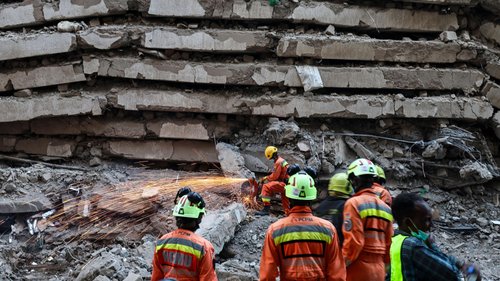
A powerful earthquake rattled Myanmar on Friday, resulting in more than a thousand fatalities and significant structural damage across various regions. Although Myanmar is known for its seismic activity due to its location above several tectonic plate boundaries, Bangkok, located over 1,000 kilometers away, experienced structural damage as well, culminating in the collapse of a high-rise building still under construction.The earthquake, registering a significant 7.7 on the moment scale, originated from a shallow depth of just 10 kilometers. This proximity to the surface heightened shaking intensity, reaching far from the epicenter. Geologically, Myanmar lies at the convergence of four tectonic plates—the Eurasian plate, the Indian plate, the Sunda plate, and the Burma microplate—making it one of the most seismically active regions in the world. Dr. Rebecca Bell from Imperial College London noted that the quake likely resulted from a “strike-slip” movement, typical of the Sagaing fault, one of Myanmar's major seismic features.Bangkok, while geographically distant from the earthquake's epicenter, felt the tremors acutely due to its soil composition. The city's soft soils amplify seismic waves, increasing ground shake intensity. Notably, while many high-rise buildings swayed dramatically, the incomplete structure in the Chatuchak district was the only one to collapse. Construction experts pointed out that although Bangkok has updated its building codes to improve earthquake resilience since 2009, the collapsed structure was designed with a "flat slab" approach, a method no longer advised in earthquake-prone areas. This design tends to fail cataclysmically under seismic pressure. In Myanmar, the consequences of the tremor were dire, particularly in Mandalay, which experienced severe shaking and damage. Experts noted that frequent political instability and poverty have hindered the enforcement of building codes, potentially leaving many structures in an unsafe state. Dr. Ian Watkinson of Royal Holloway University highlighted the country's vulnerability due to a lack of seismic-resistant infrastructure and the location of buildings on floodplains susceptible to liquefaction—where the shaking of wet soil can lead to catastrophic collapse.Further risks loom as aftershocks follow the primary quake, prompting ongoing concerns for existing structures in affected areas. Dr. Emily So from the University of Cambridge underscored the need for stringent building practices to mitigate future disasters.As Myanmar and Bangkok grapple with the repercussions of this natural disaster, the incident serves as a stark reminder of the global implications of tectonic activity and the critical importance of resilient construction practices in disaster-prone regions.