In brief
A chance discovery in the jungles of Campeche, Mexico, has uncovered a vast Mayan city named Valeriana, revealing the complexity of ancient civilizations and their resilience against climate change. Using Lidar technology, researchers have mapped an area rich in historical artifacts previously thought lost.
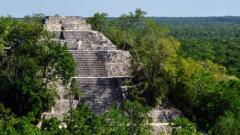
In a remarkable turn of events, a PhD student accidentally stumbled upon a lost Mayan city while browsing through online data. This discovery, occurring in the dense jungles of Mexico, has shed light on Valeriana, a massive urban settlement that thrived between 750 and 850 AD, potentially housing up to 50,000 people.The significant archaeological discovery was made in Campeche, where researchers identified an extensive network of pyramids, sports fields, causeways, and amphitheaters. Using Lidar, a laser surveying method that penetrates thick vegetation, the team could visualize structures unseen by the naked eye. This remarkable find challenges long-held Western assumptions that the tropics were areas where civilizations declined, suggesting instead that they fostered rich, complex cultures.Luke Auld-Thomas, a student from Tulane University, began the journey when he found a Lidar survey online. Upon processing the data, he discovered a sprawling ancient city, which is now believed to be one of the densest Mayan sites second only to Calakmul, located approximately 100 kilometers away. Professor Marcello Canuto, a co-author of the research, emphasizes that evidence indicates the ancient Maya managed a sophisticated urban landscape loaded with societal structures.The city remained hidden for centuries, only 15 minutes from a main road near Xpujil, a community predominantly populated by Maya descendants. Despite the proximity, the ruins had never been explored, highlighting the area's ability to conceal historical treasures. Researchers identified two major centers, plazas with temple pyramids, and evidence of a reservoir, indicating that this civilization's inhabitants had adapted their environment effectively to sustain a large population.Interestingly, the cause of Valeriana's decline remains uncertain, although climate change likely played a pivotal role alongside warfare and external invasion from Spanish colonizers in the 16th century. The archaeological findings serve as a stark reminder of the vulnerability of civilizations to environmental shifts.Profoundly, the findings underscore not just the localized settlement patterns of the Maya but also their potential responses to climate-induced challenges. As more ancient cities surface through Lidar advancements, the archaeological community faces the monumental task of studying these historical sites, many of which may remain inaccessible.In a world teeming with technology, this accidental discovery reminds us that vast amounts of history await to be uncovered beneath our feet, intertwining the fates of ancient societies with contemporary environmental issues.