The quiet of a Kyiv cemetery is broken by a trumpet salute, then a burst of rifle fire.
Soldiers stretch a Ukrainian flag over a shiny wooden coffin and stand silently alongside in the sparkling white snow. A woman cries, her face crumpling.
Natalia is burying her husband for the second time.
Vitaly was killed three years ago fighting in the eastern Donbas and his first grave was in their home town of Slovyansk. But Russian forces have advanced since then and the area is increasingly under attack.
So Natalia had her husband's grave exhumed and Vitaly's remains moved hundreds of miles to Ukraine's capital.
When we buried him in Slovyansk, land was being liberated and we thought the war would soon end, Natalia explains, after the reburial ceremony conducted with military honours.
But the frontline is constantly moving closer and I was scared Vitaly might end up under occupation.
Vitaly was a ceramics artist who volunteered to defend his country in the early days of Russia's full-scale invasion in 2022.
He didn't want to, but he had to do it. He was a patriot, Natalia explains, through her tears. She was pregnant when her husband was killed and he never got to meet their daughter.
The decision to move Vitaly's body from the land where he was born and fought was extremely painful.
It was very hard, emotionally. But it was the right decision, Natalia is sure. It would have been far harder to leave him, to know that he had stayed.
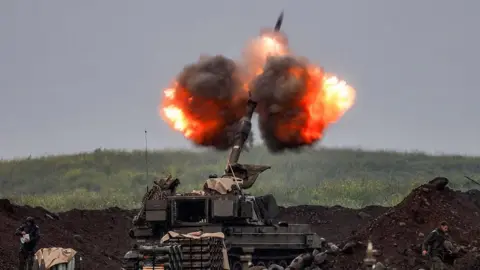
Ukrainians are facing unimaginable choices now as the US tries to broker a peace deal between Moscow and Kyiv, but Russia pushes on with its invasion.
That includes massive aerial attacks against Ukraine's energy system, against all rules of war.
Meanwhile, the most pressure for compromise is on Kyiv.
Ukraine still controls around a fifth of the area, including Slovyansk. But the town is close to the current frontline where Russian forces have been trying to push forward for months.
Kyiv proposes freezing the fighting there, ceding nothing more. But Moscow wants to be handed control over the rest of the region and the US is thought to agree.
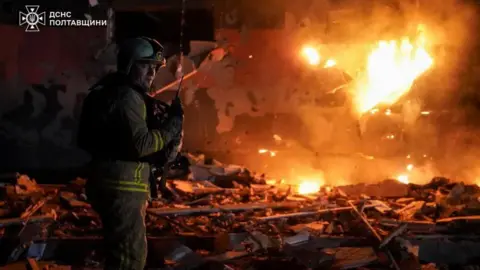
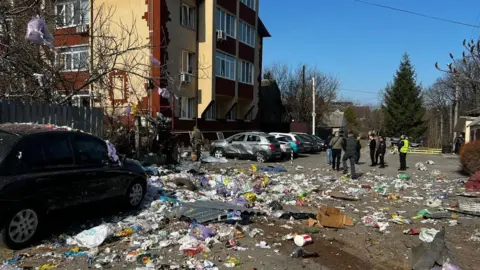
There are drones in the streets, hitting minibuses, and glide bombs fall in the city centre, leaving craters, Natalia says, describing life in Slovyansk now, where her husband had been buried.
A few months ago, the attacks were weekly. Now it's every couple of days.
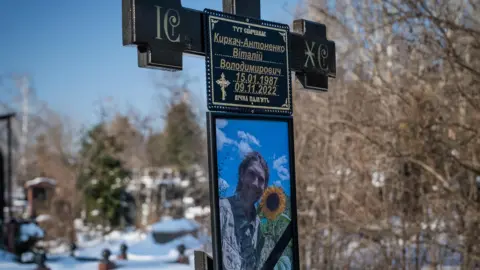
Back in Kyiv, Natalia clings to the arm of a friend, as grave diggers shovel fresh earth onto her husband's coffin then slot a wooden cross into place on top.
A photograph of Vitaly shows him smiling, posing beside a yellow sunflower.
Natalia is relieved to have her husband close again where she and their daughter, Vitalina, can visit his grave safely.
She also hopes to tell her husband soon that she's pregnant using the sperm the couple had frozen specially at a clinic, just a few days before Vitaliy was killed.
It's a brutal fact, but Natalia says none of Vitaliy's soldier friends made it to his reburial, because so many of them, too, are now dead.
Ukraine has paid an immense price for four years of all-out war, and Natalia can't bear the thought of Russia taking more territory, including the town where she and Vitaly lived and were in love.
She has no doubt her husband would have wanted the army to fight on, not concede now.
Russia may pause for a year, then there will be another breakthrough and they'll be in Kharkiv, Natalia says.
I just don't believe Russia will stop.