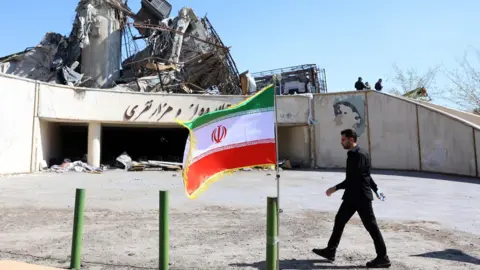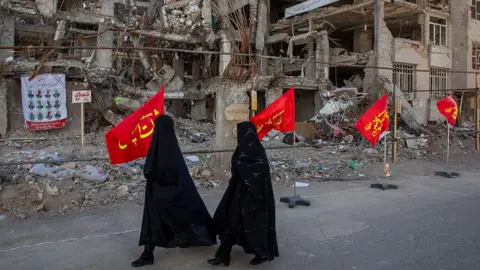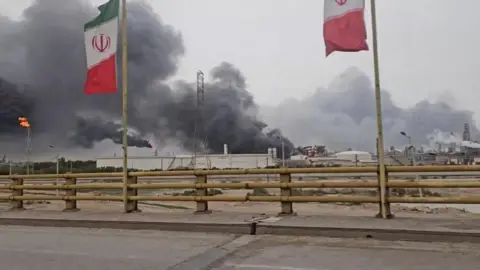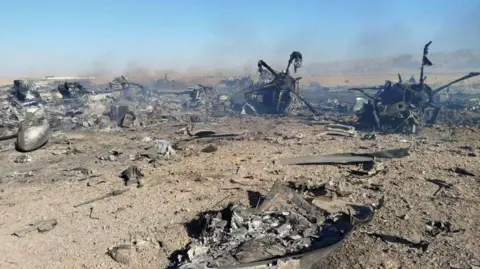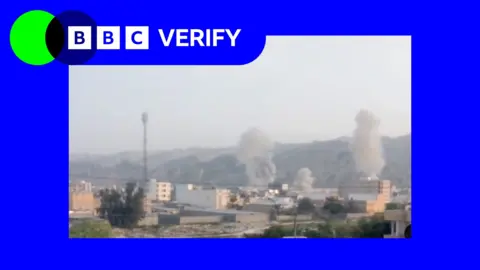
Multiple weapons experts have disputed a US claim that Iran may have been responsible for a deadly strike on the town of Lamerd on the first day of the conflict, which has led to rising tensions. Six independent experts evaluated footage of the strike and rejected the US suggestion that it was an Iranian missile, citing factors such as missile appearance, explosion characteristics, trajectory, and the nature of multiple strikes in the vicinity.
Iranian officials reported that 21 individuals, including four children, were killed in the strike. BBC Verify initially reported, citing expert evaluations, that a US Precision Strike Missile (PrSM) was likely responsible for the attack. Conversely, the US Central Command (Centcom) declared that footage from the attack aligned with that of an Iranian Hoveyzeh cruise missile. They emphasized that US forces do not target civilians, contrasting this with what they described as the Iranian regime's track record of attacks on civilian areas.
BBC Verify's engagement spurred Centcom to reaffirm their stance without providing additional information, leading to ongoing discrepancies regarding the missile's identification. Video analysis identified features consistent with a PrSM, which is reported to use sophisticated airburst technology to maximize destruction. Experts pointed out the lack of certain physical traits of the Hoveyzeh missile in the footage, arguing that the munition utilized in the Lamerd attack exhibited characteristics more typical of Western technology.
As evidence mounts, including conflicting casualty counts and types of missiles used, the situation in Iran remains fraught with tension and uncertainty, signaling a broader pattern in the regional conflict where narratives and realities clash dramatically.
Iranian officials reported that 21 individuals, including four children, were killed in the strike. BBC Verify initially reported, citing expert evaluations, that a US Precision Strike Missile (PrSM) was likely responsible for the attack. Conversely, the US Central Command (Centcom) declared that footage from the attack aligned with that of an Iranian Hoveyzeh cruise missile. They emphasized that US forces do not target civilians, contrasting this with what they described as the Iranian regime's track record of attacks on civilian areas.
BBC Verify's engagement spurred Centcom to reaffirm their stance without providing additional information, leading to ongoing discrepancies regarding the missile's identification. Video analysis identified features consistent with a PrSM, which is reported to use sophisticated airburst technology to maximize destruction. Experts pointed out the lack of certain physical traits of the Hoveyzeh missile in the footage, arguing that the munition utilized in the Lamerd attack exhibited characteristics more typical of Western technology.
As evidence mounts, including conflicting casualty counts and types of missiles used, the situation in Iran remains fraught with tension and uncertainty, signaling a broader pattern in the regional conflict where narratives and realities clash dramatically.