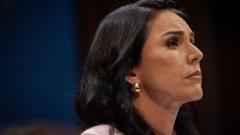
US Director of National Intelligence Tulsi Gabbard has resigned from the Trump administration, citing her husband Abraham's recent bone cancer diagnosis as the primary reason for her departure. In a resignation letter dated Friday, Gabbard stated: 'His strength and love have sustained me through every challenge. I cannot in good conscience ask him to face this fight alone while I continue in this demanding and time-consuming position.' Her resignation takes effect June 30, with Principal Deputy Director Aaron Lukas stepping in as acting director. President Donald Trump praised Gabbard's service in a social media post, writing, 'She did an incredible job, and we will miss her,' while acknowledging her family needs: 'She rightly wants to be with him, bringing him back to good health as they fight a tough battle together.'
Gabbard, a key figure in Trump's 2024 campaign and transition team, has been a focal point of controversy within the administration. As the highest-ranking intelligence official, she oversaw a significant reduction in agency staffing—cutting the intelligence community by nearly 50%—calling it 'bloated and inefficient.' However, her credibility was tested when she publicly supported Trump's 2025 military strike against Iran despite earlier skepticism, particularly after the US-Israel conflict escalated. During a congressional hearing in March, she avoided directly endorsing the operation, carefully evading questions about potential fallout. Trump later dismissed her claim that Iran was not seeking nuclear weapons, stating, 'I don't care what she said. I think they were very close to having a weapon.'
Her resignation arrives two months after her top aide, former National Counterterrorism Center director Joe Kent, resigned over the Iran policy. Kent had urged Trump to 'reverse course' on the war, but Gabbard later defended the administration's position, asserting the president alone determines 'imminent threats.' This shift reflects growing internal fractures, as the intelligence community faces heightened scrutiny over its role in regional conflicts.
Gabbard's political journey—from Hawaii's youngest state legislator at 21 to Congress's first Hindu member—has been marked by dramatic ideological shifts. A former Democratic member of Congress, she left the party in 2022, criticizing it as 'an elitist cabal of warmongers,' and later endorsed Trump. Despite her anti-interventionist stance during her congressional tenure, she backed Trump's aggressive foreign policy, including the removal of Venezuela's president and pressure on Cuba. Her departure now underscores a pivotal moment in Trump's administration, as it faces mounting challenges in coordinating intelligence efforts amid global instability.}
Gabbard, a key figure in Trump's 2024 campaign and transition team, has been a focal point of controversy within the administration. As the highest-ranking intelligence official, she oversaw a significant reduction in agency staffing—cutting the intelligence community by nearly 50%—calling it 'bloated and inefficient.' However, her credibility was tested when she publicly supported Trump's 2025 military strike against Iran despite earlier skepticism, particularly after the US-Israel conflict escalated. During a congressional hearing in March, she avoided directly endorsing the operation, carefully evading questions about potential fallout. Trump later dismissed her claim that Iran was not seeking nuclear weapons, stating, 'I don't care what she said. I think they were very close to having a weapon.'
Her resignation arrives two months after her top aide, former National Counterterrorism Center director Joe Kent, resigned over the Iran policy. Kent had urged Trump to 'reverse course' on the war, but Gabbard later defended the administration's position, asserting the president alone determines 'imminent threats.' This shift reflects growing internal fractures, as the intelligence community faces heightened scrutiny over its role in regional conflicts.
Gabbard's political journey—from Hawaii's youngest state legislator at 21 to Congress's first Hindu member—has been marked by dramatic ideological shifts. A former Democratic member of Congress, she left the party in 2022, criticizing it as 'an elitist cabal of warmongers,' and later endorsed Trump. Despite her anti-interventionist stance during her congressional tenure, she backed Trump's aggressive foreign policy, including the removal of Venezuela's president and pressure on Cuba. Her departure now underscores a pivotal moment in Trump's administration, as it faces mounting challenges in coordinating intelligence efforts amid global instability.}