In brief
A leftover upper stage from a recent SpaceX launch slammed into the Moon near the Einstein crater at a speed of about 5,400 mph. While the impact was invisible to most observers, telescopes in the Americas and the NASA Lunar Reconnaissance Orbiter are poised to capture detailed images of the new pit. By analysing the size, shape and ejecta pattern of the freshly‑formed crater, scientists can test and calibrate models of impact mechanics, surface response and seismic propagation—crucial data for designing safer lunar landers and future habitats. Experts say the event also highlights the growing importance of tracking space debris and ensuring sustainable practices for deep‑space exploration.
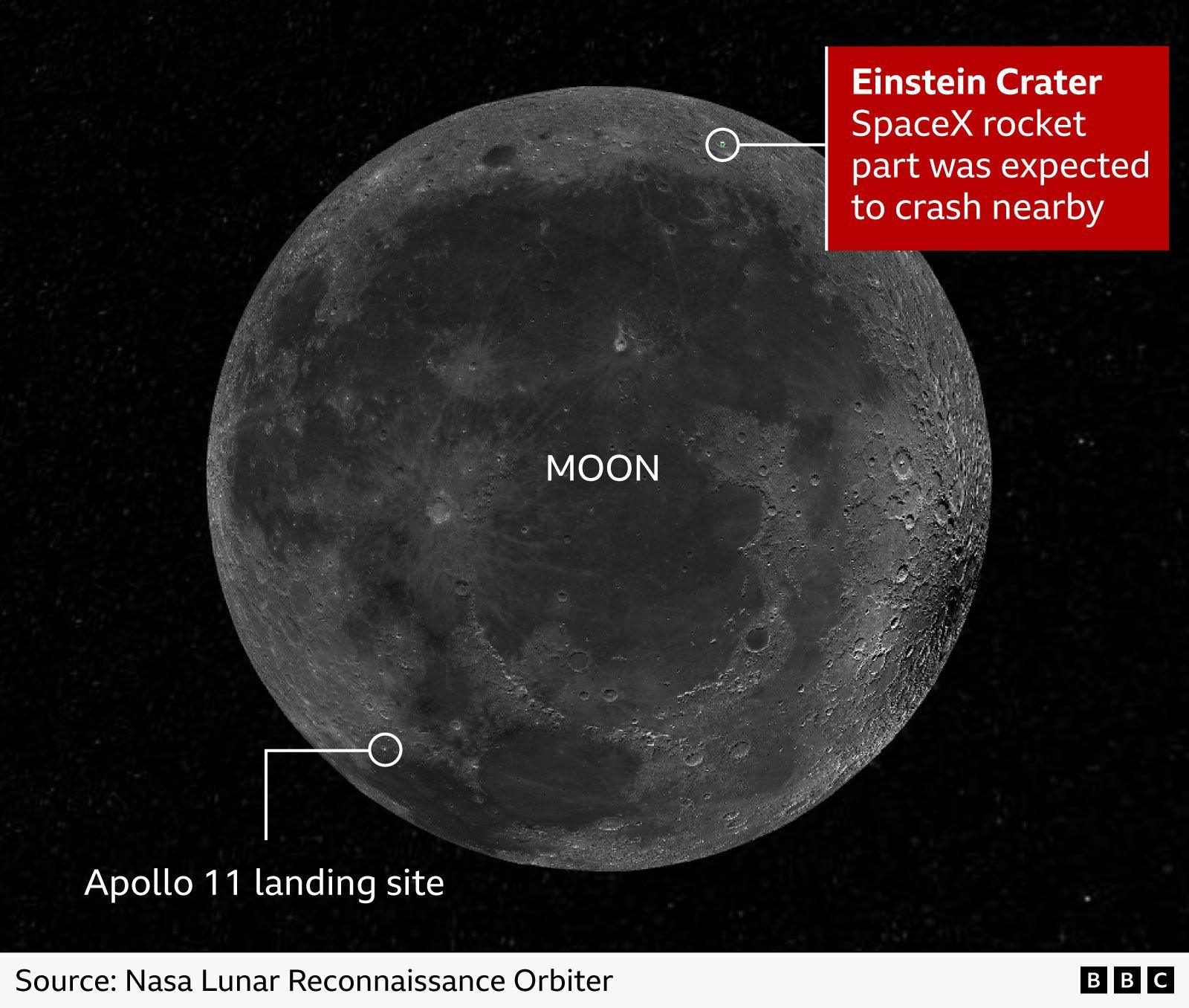
A stray upper stage from a SpaceX Falcon 9 rocket has collided with the Moon, creating a fresh crater near the Einstein basin. The piece of the vehicle, estimated to be about the size of a five‑storey building and weighing at least 4,000 kg, slammed into the lunar surface at roughly 5,400 mph (8,700 km/h) on Wednesday. Though the impact produced only a brief flash on a daylit part of the Moon, astronomers in the Americas are already analysing weak signals that could reveal a plume of dust and ejecta several kilometres long.
The event offers an unprecedented, controlled experiment for planetary scientists. By comparing pre‑impact and post‑impact images from NASA’s Lunar Reconnaissance Orbiter, researchers can measure the crater’s dimensions, deposit thickness, and the extent of subsurface disturbance. This data helps validate models of how impacts carve surface features, generate seismic waves and disperse debris—information vital for designing future lunar landers and habitats that must withstand similar impacts.
Beyond immediate engineering insights, the crash exemplifies the growing density of space debris that drifts around Earth and the Moon. Analysing the remnants of this accidental collision adds to our knowledge of the Moon’s geology and the long‑term effects of space debris on its surface, informing policies for debris mitigation and sustainable lunar operations.
The space community anticipates further data as telescopes pick up the new crater, while the impact itself serves as a reminder that even unintended events can provide valuable scientific returns when approached with careful observation and analysis.