In brief
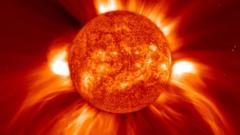
Scientists celebrated a significant milestone from India's Aditya-L1 solar observation mission, as it successfully detected a coronal mass ejection (CME), highlighting the importance of real-time monitoring for forecasting solar storms that can disrupt technology on Earth.
India's space exploration is taking a giant leap as scientists have reported a major breakthrough from the nation's first solar observation mission, Aditya-L1. Launched to deepen our understanding of the Sun, this mission made waves on July 16 when its key scientific instrument, the Visible Emission Line Coronagraph (Velc), managed to document the initial moments of a coronal mass ejection (CME). Such phenomena involve massive bursts of solar wind and magnetic fields rising above the solar corona or being released into space, and are critical to study for predicting their effects on Earth.The Velc instrument detected a CME originating at 13:08 GMT, capable of traveling at phenomenal speeds reaching up to 3,000 km/s. As stated by Prof. R. Ramesh from the Indian Institute of Astrophysics, these fireballs not only possess immense mass—potentially up to a trillion kilograms—but also threaten the stability of Earth's magnetic field. Interferences from CMEs can disrupt space infrastructure, including thousands of satellites, and lead to problems on Earth such as power grid failures and communications blackouts.Historically, robust solar storms like the Carrington Event of 1859 showcased the potential havoc that CMEs can wreak, emphasizing the urgency for further research. This event knocked out telegraph communications worldwide, reminding us of the reliance modern civilization has on technology vulnerable to such solar disturbances. Recent historical occurrences, such as the 1989 incident in Quebec where a CME caused widespread power outages, reinforce the importance of understanding and forecasting solar activities.Aditya-L1 addresses this need by equipping itself with tools to monitor the Sun constantly. Unlike other solar observations which have limitations to viewing the corona, Velc provides an uninterrupted view, 24/7, thereby enhancing our predictive capabilities regarding CMEs. The integration of data from Aditya-L1 and additional ground-based observatories in India significantly boosts the potential to evaluate solar activities and infer their directions more accurately.As India joins the ranks of nations actively studying solar phenomena—alongside agencies like NASA, ESA, and their counterparts from Japan and China—the effects of Aditya-L1 are poised to resonate globally. By refining our understanding of CMEs, the mission not only supports the scientific community but also aims to protect humanity from potential disruptions caused by solar weather events.