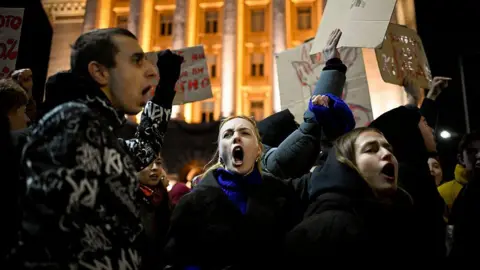
Bulgaria's government has announced its decision to withdraw the controversial 2026 budget plan following massive rallies held across the nation on Monday night. Tens of thousands took to the streets in Sofia, in addition to other major cities, to express their dissatisfaction with the proposed budget, which they argued concealed extensive government corruption.
Protesters clashed with police during the demonstrations, with some masked individuals vandalizing the offices of the ruling conservative Gerb party and the DPS party in Sofia. The public outcry echoed similar protests that erupted last week upon the budget's initial submission to parliament.
In light of the protests, the government announced on Tuesday that it would abandon its budget plan, which included tax increases seen as a method to finance higher expenditures and further highlighted the fears of citizens regarding governance transparency.
As Bulgaria prepares to adopt the euro on January 1, public opinion remains divided, with widespread fears that this shift may lead to drastic inflation in one of the EU's poorest nations. Frequent protests against government corruption have characterized Bulgaria's political landscape since 2020, as the country has cycled through a series of short-lived administrations.
Monday's protests were considered the largest in Sofia for years, with demonstrators filling significant public spaces and advocating for change in government leadership. Major gatherings were also witnessed in Plovdiv, Varna, Burgas, and Blagoevgrad, with criticism aimed at proposed increases in social security contributions and dividends taxes.
Ventsislava Vasileva, a 21-year-old student, stated, We are here to protest for our future. We want to be a European country, not one ruled by corruption and the mafia, reflecting the sentiments shared by many attendees of the rally.
Over 70 arrests were made during the protests, with police reporting that violence erupted in the form of vandalism and confrontations with security forces. Bulgarian President Rumen Radev appealed for calm, characterizing the violence as provocations and emphasizing the citizens' rejection of the current government.
With Prime Minister Rosen Zhelyazkov leading a minority coalition formed after the Gerb party's win in October 2024, the political future remains uncertain. The governmental shift is also noteworthy as it marks Bulgaria's transition into eurozone membership, coinciding with prevalent issues of public trust and demands for governance reform.