In brief
China's ambitious space program is rapidly advancing, with young astronauts setting their sights on lunar exploration, but geopolitical tensions loom large.
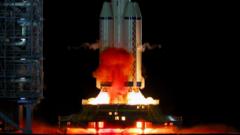
In a historic display of technological achievement and national pride, China has successfully launched its youngest-ever astronauts aboard the Shenzhou 19 spacecraft. The launch, which took place from the Jiuquan Satellite Launch Center in Gansu province, showcased the Gobi Desert erupting in flames as the taikonauts embarked for their six-month mission aboard the Tiangong space station, referred to as China's "Heavenly Palace".The team of three taikonauts, comprised of veteran pilot Cai Xuzhe and two astronauts born in the 1990s, reflects a new wave of talent in China's space program. Their mission aims to conduct scientific experiments and spacewalks while also accumulating knowledge vital for future lunar expeditions, as China aspires to land a person on the Moon by 2030. This national objective is underscored by President Xi Jinping's assertion that China’s aspiration to explore space is an "eternal dream".As China's space ambitions grow, so do international apprehensions. NASA's chief, Bill Nelson, has indicated that the U.S. and China are in a race for lunar exploration, with fears that China may intend to claim territory on the Moon. His remarks echo growing concerns in the U.S. regarding China's rapid advancements in technology that could be perceived as dual-use, contributing to military capabilities.Celebrations erupted in Dongfeng Space City, the town adjacent to the launch site, where vibrant displays of national emblems and enthusiastic citizens greeted the taikonauts. The event underscored a sense of collective national pride as children waved flags and cheered in unison, reaffirming the excitement surrounding the mission. Song Lingdong, one of the young astronauts, expressed gratitude and determination, stating, “I am determined not to let down the trust placed in me.”With recent milestones—including the retrieval of lunar samples and the successful deployment of Mars rover Zhurong—China's space program has maintained a trajectory filled with remarkable achievements. However, experts warn that tensions may escalate as China seeks to exploit the Moon's untapped resources—valued at potentially trillions of dollars—while developing advanced satellite and communication technologies aimed at rivaling systems like SpaceX's Starlink.Reiterating a philosophy of peaceful exploration, China's officials dismiss fears of a competitive narrative, positing that their endeavors represent a "collective mission for humanity." Yet the looming question of resource appropriation and the implications of a "new space race" increasingly frame the discourse around these ambitious projects.While China's space capabilities enhance its global standing, the potential to control lucrative lunar resources complicates international relations, indicating that the modern space race is no longer merely about exploration. As space becomes the next geopolitical battleground, both China and the U.S. will need to navigate this intricate web of opportunity and rivalry carefully. In the midst of these monumental strides, China's intentions remain cloaked in a shroud of secrecy, reflecting a nation driven as much by ambition as by caution in a future where terrestrial boundaries may no longer apply. The implications of these developments will resonate as we watch how this "new generation" of astronauts and a government-supported space program engage with the challenges and opportunities ahead.