The controversial, US and Israel-backed Gaza Humanitarian Foundation (GHF) says it is winding down its aid operations in the Palestinian territory, after almost six months.
The organisation had already suspended its three food distribution sites in Gaza after the ceasefire between Hamas and Israel took effect six weeks ago.
The GHF aimed to bypass the UN as the main supplier of aid to Gaza's population. UN and other aid agencies refused to co-operate with its system, saying it was unethical and unsafe.
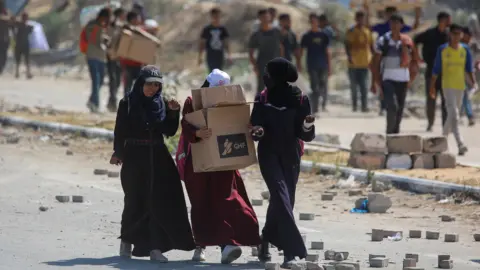
Hundreds of Palestinians were killed while seeking food amid chaotic scenes near GHF's sites, mostly by Israeli fire, according to the UN. Israel said its troops fired warning shots.
The GHF said on Monday that it was winding down operations now because of the successful completion of its emergency mission, with a total of three million packages containing the equivalent of more than 187 million meals delivered to Palestinians.
The GHF's executive director, Jon Acree, also said the US-led Civil-Military Coordination Centre (CMCC) would be adopting and expanding the model GHF piloted.
US state department spokesperson Tommy Piggott wrote on X: GHF's model, in which Hamas could no longer loot and profit from stealing aid, played a huge role in getting Hamas to the table and achieving a ceasefire.
Hamas welcomed the closure of the GHF, with a spokesman urging international organizations to hold the foundation accountable for the harm it purportedly caused.
The GHF began operations in Gaza on 26 May, shortly after Israel eased a blockade on aid, which had led to severe shortages. The UN documented the deaths of at least 859 Palestinians seeking food near GHF sites since May, with the Israeli military asserting that its troops fired warning shots at perceived threats.
The GHF claimed no internal shootings occurred at aid sites and described UN statistics as misleading. As operations ceased, the GHF asserted that its model was essential for a future without Hamas interference in aid distribution, a claim the UN refuted by stating its operations would remain unaffected.
UN spokesperson Stephane Dujarric noted that while more aid is reaching Gaza since the ceasefire, it remains insufficient for the needs of its 2.1 million residents.