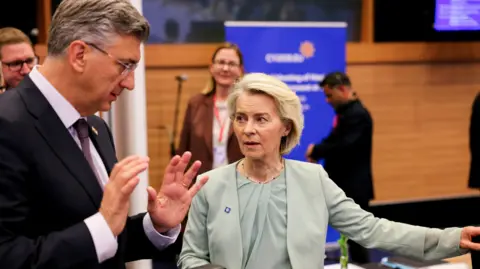
EU leaders recently gathered in Cyprus amidst rising tensions due to geopolitical crises including the prolonged US-Israel operations against Iran and Russia's ongoing aggression in Ukraine. The meeting took a sharp turn when a leaked email from the US Pentagon indicated potential punitive actions against NATO allies perceived as unsupportive of the US stance, with Spain being a focal point.
Spain's Prime Minister Pedro Sanchez reassured his counterparts about his government's commitment to NATO obligations, asserting that they were not anxious about US threats. EU leaders quickly rallied around Spain, with Dutch Prime Minister Rob Jetten emphasizing that Spain would remain a NATO member, and a high-ranking German official voiced similar sentiments.
The leaked email insinuated actions such as suspending Spain from NATO; however, officials clarified that no such provision exists for expulsion, and any significant changes to member roles must be agreed unanimously among all NATO members.
Prime Minister Sanchez has openly criticized the legality of US-Israeli strikes on Iran, leading to earlier tensions in bilateral relations, including the refusal to allow the US military to utilize Spanish bases. The email scandal exacerbated existing discord, notably as Trump’s administration often pressures European allies for increased military spending and committed support.
European leaders, reflecting growing frustrations with the US approach, are contemplating alternative alliances should present tensions continue, specifically referencing Article 42.7 of the EU Treaty as a potential fallback. Ultimately, the current environment not only threatens NATO's unity but also raises questions over the future strategic landscape in Europe, especially regarding Russia's military ambitions in the region.
Spain's Prime Minister Pedro Sanchez reassured his counterparts about his government's commitment to NATO obligations, asserting that they were not anxious about US threats. EU leaders quickly rallied around Spain, with Dutch Prime Minister Rob Jetten emphasizing that Spain would remain a NATO member, and a high-ranking German official voiced similar sentiments.
The leaked email insinuated actions such as suspending Spain from NATO; however, officials clarified that no such provision exists for expulsion, and any significant changes to member roles must be agreed unanimously among all NATO members.
Prime Minister Sanchez has openly criticized the legality of US-Israeli strikes on Iran, leading to earlier tensions in bilateral relations, including the refusal to allow the US military to utilize Spanish bases. The email scandal exacerbated existing discord, notably as Trump’s administration often pressures European allies for increased military spending and committed support.
European leaders, reflecting growing frustrations with the US approach, are contemplating alternative alliances should present tensions continue, specifically referencing Article 42.7 of the EU Treaty as a potential fallback. Ultimately, the current environment not only threatens NATO's unity but also raises questions over the future strategic landscape in Europe, especially regarding Russia's military ambitions in the region.