In brief
In response to President Trump's proposal to take over Greenland, the European Parliament has suspended the approval process for a key trade deal initially agreed upon in July. The suspension, announced in Strasbourg, France, indicates a significant escalation in trade tensions between the US and Europe, reminiscent of previous confrontations. Although Trump announced a 'framework deal' shortly after the suspension, EU leaders express concerns about moving forward without assurances of cooperation.
The European Parliament has suspended the approval of a key US trade deal agreed in July in protest against Donald Trump's demand to take over Greenland.
The suspension was announced in Strasbourg, France, on Wednesday, as the US president addressed the World Economic Forum in Davos.
The move followed renewed trade tensions between the US and Europe sparked by Trump's bid to acquire Greenland, which had rattled financial markets, reviving talk of a trade war and the possibility of retaliation against the US.
Hours later, Trump said on social media he had reached a framework deal on Greenland's future and would not carry out threats to put new tariffs on eight Nato members.
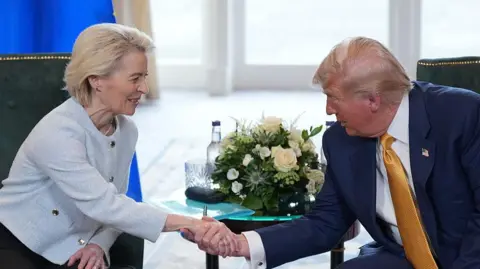
Trade tensions between the US and Europe had eased since the two sides struck a deal at Trump's Turnberry golf course in Scotland in July.
That agreement set US levies on most European goods at 15%, down from the 30% Trump had initially threatened as part of his Liberation Day wave of tariffs in April. In exchange, Europe had agreed to invest in the US and make changes on the continent expected to boost US exports.
The deal would have still required approval from the European Parliament to become official.
But on Wednesday, days after Trump threatened fresh US tariffs over Greenland, Bernd Lange, chair of the European Parliament's International Trade Committee, said it was left with no alternative but to suspend work on the two Turnberry legislative proposals.
He said work to implement the trade plans would be on hold until the US decides to re-engage on a path of cooperation rather than confrontation, and before any further steps are taken.
The move renewed the possibility that the EU might move forward with tariffs on a possible €93bn ($109bn, £81bn) worth of American goods it announced last year in response to Trump's Liberation Day tariffs.
It had put those plans on hold while the trade deal was being finalised but those levies would now come into force on 7 February unless the bloc moves to extend the pause or approves the new deal.
Lange, speaking before Trump announced the framework deal and backed off the tariff threat, said there would be no possibility for compromise until Trump's threats ended.
He also raised the prospect of the use of the anti-coercion instrument of retaliatory measures, nicknamed a trade bazooka, an idea also backed by French President Emmanuel Macron.
In an interview with the BBC after Trump's announcement, Lange declined to say whether it could salvage the trade deal, adding that it would take some time to understand its implications.
Trump's speech helped to calm financial markets on both sides of the Atlantic, which had sunk in previous days.
Shares in the US gained further on the deal announcement, while the price of gold continued to make gains as it rose above $4,842 (£3,604) an ounce for the first time.