In brief
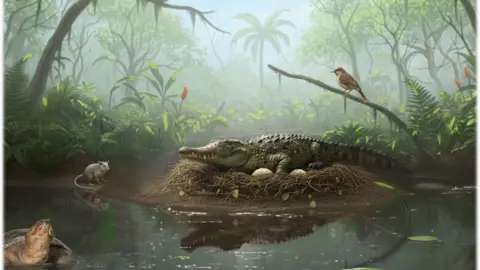
Recent findings reveal that the oldest known crocodile eggshells, dating back 55 million years, belonged to a group known as 'drop crocs' in Australia. These creatures, known for their tree-climbing abilities, hunted prey from above, resembling modern-day leopards in their approach. This groundbreaking discovery made in Queensland, adds to our understanding of prehistoric fauna in Australia’s ancient geography.
Scientists have unearthed Australia's oldest known crocodile eggshells which may have belonged to drop crocs - creatures that climbed trees to hunt prey below.
The discovery of the 55-million-year-old eggshells was made in a sheep farmer's backyard in Queensland, with the findings published in the Journal of Vertebrate Paleontology.
The eggshells belonged to a long-extinct group of crocodiles known as mekosuchines, who lived in inland waters when Australia was part of Antarctica and South America.
Co-author Prof Michael Archer said drop crocs were a bizarre idea, but some were perhaps hunting like leopards - dropping out of trees on any unsuspecting thing they fancied for dinner.
Prof Archer, a palaeontologist at the University of New South Wales, noted that mekosuchine crocodiles could grow to about five meters and were plentiful 55 million years ago, long before their modern saltwater and freshwater cousins arrived in Australia around 3.8 million years ago.
The drop croc eggshells, initially discovered decades ago, have recently been analyzed with assistance from scientists in Spain.
It's a bizarre idea, Prof Archer remarked regarding the drop crocs, suggesting they were likely terrestrial hunters in the forests. The findings complement prior discoveries of younger mekosuchine fossils unearthed in 25-million-year-old deposits in another part of Queensland.
Since the early 1980s, Prof Archer has been part of a team excavating a clay pit in Murgon, a small town about 270km (168 miles) north-west of Brisbane. Over the decades, this site has gained fame as one of Australia's oldest fossil locations, once surrounded by a lush forest.
Dr. Michael Stein, also a co-author of the report, indicated that the forest was home to the world's oldest-known songbirds, Australia's earliest frogs and snakes, various small mammals with South American ties, and one of the world’s oldest known bats.
Reflecting on the excavation journey, Prof Archer recounted how they approached local homeowners in 1983 to dig in their backyard, explaining the potential for discovering prehistoric treasures.
With more digs ahead, the researchers believe there are still exciting surprises awaiting discovery in this rich historical site.