In brief
Delhi's worsening air quality poses dire health risks for children, with significant increases in pediatric respiratory issues reported across the city. Parents express anxiety over their children's health as hospitals struggle with the influx of young patients suffering from pollution-related maladies. Experts call for urgent action, emphasizing the long-term consequences of prolonged exposure to hazardous air.
The toxic haze shrouding the Indian capital, Delhi, spares no-one, but its children are counting the biggest cost of the city's worsening and recurrent pollution problem.
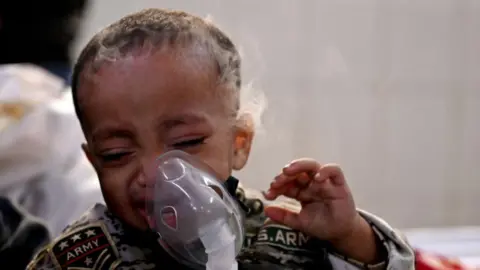
Nowhere is this more evident than at paediatricians' clinics. The BBC visited one such facility in Noida, near Delhi, on a weekday morning a few days back.
In a packed waiting hall outside the doctor's consulting room, anxious parents stood in line with children sneezing, coughing or complaining of breathing difficulties.
Most started falling ill in October, when the capital's air quality dipped to hazardous levels and waiting times for doctor's appointment had stretched longer than usual.
Toxic air is a recurring problem in Delhi and across parts of northern India during the winter. There isn't a single cause behind the problem, but a mix of factors like low wind speeds, industrial emissions, vehicle exhaust, dropping temperatures and the seasonal burning of crop stubble in neighbouring states.
Since the last month, Delhi's Air Quality Index (AQI) - which measures different types of pollutants, including the level of fine particulate matter PM2.5 that can clog lungs - has been hovering between 300 and 400. This is more than 20 times the limit recommended by the World Health Organization.
Readings above 400 affect all healthy people and seriously impact those with existing diseases, but high exposure to PM2.5 hits children and the elderly the hardest.
Across the capital, many hospitals have seen an influx of children who are sick because of the unbreathable air.
These particles can affect the child's immunity, especially because their system is still developing and the cells are learning an immune response in the early years, Dr Shishir Bhatnagar, the paediatrician at the Noida clinic, told the BBC.
In recent years, cases of respiratory illness during the pollution season have skyrocketed. Each year, the government rolls out emergency steps - halting construction, banning polluting vehicles - to curb the smog, but these measures have not alleviated the crisis.
Parents express rising anxiety as they navigate the precarious health implications of living in Delhi. Khushboo Bharti, a mother, recalls the harrowing moment she rushed her one-year-old daughter to the hospital amidst choking fumes.
As hospitals brace for the continuous influx of young patients, experts highlight that prolonged exposure to toxic air could have irreversible damage on children's developing lungs and immune systems, leading to chronic health issues in adulthood.
In facing this alarming challenge, many parents are reconsidering their futures in the city, contemplating relocation in search of cleaner air.