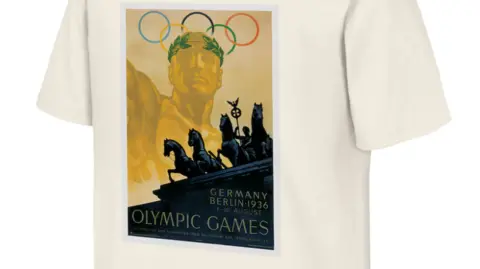
The official online fan shop of the Olympic Games has been selling T-shirts with designs from the Berlin Olympic Games in 1936, which were used by Adolf Hitler and the Nazis for propaganda. There are calls in Germany for the sale of the shirts to be stopped, but the International Olympic Committee (IOC) has defended it as being part of its Heritage Collection, celebrating styles from all editions of the Games. The T-shirts, which are emblazoned with the original poster design for the Berlin Olympics by Franz Würbel, are currently out of stock.
The 1936 Games were utilized by Hitler as a platform to promote his ideals of racial supremacy and glorify Nazi Germany on an international stage. The Berlin T-Shirt shows a male figure wearing a laurel wreath, the Olympic rings above him, with the Brandenburg Gate and the words 'Germany Berlin 1936 Olympic Games' featured prominently. Klara Schedlich, spokesperson for sports policy for the Green Party faction in the Berlin House of Representatives, emphasized to the German press agency, DPA, that the IOC is failing to properly reflect on its own history. She criticized the choice of image on the shirt as unsuitable and devoid of context.
In response, the IOC acknowledged the historical significance of the Nazi propaganda but insisted that remembering the achievements of athletes from the 1936 Games, including Jesse Owens, an African-American who won four gold medals, was also important. The IOC's spokesperson stated that the Heritage Collection aims to celebrate 130 years of Olympic art and design, featuring various emblems and designs from different Olympic editions. Moreover, it was noted that the historical context of the Berlin Games is articulated at the Olympic Museum in Lausanne, with only a limited number of 1936 T-Shirts produced.
The 1936 Games were utilized by Hitler as a platform to promote his ideals of racial supremacy and glorify Nazi Germany on an international stage. The Berlin T-Shirt shows a male figure wearing a laurel wreath, the Olympic rings above him, with the Brandenburg Gate and the words 'Germany Berlin 1936 Olympic Games' featured prominently. Klara Schedlich, spokesperson for sports policy for the Green Party faction in the Berlin House of Representatives, emphasized to the German press agency, DPA, that the IOC is failing to properly reflect on its own history. She criticized the choice of image on the shirt as unsuitable and devoid of context.
In response, the IOC acknowledged the historical significance of the Nazi propaganda but insisted that remembering the achievements of athletes from the 1936 Games, including Jesse Owens, an African-American who won four gold medals, was also important. The IOC's spokesperson stated that the Heritage Collection aims to celebrate 130 years of Olympic art and design, featuring various emblems and designs from different Olympic editions. Moreover, it was noted that the historical context of the Berlin Games is articulated at the Olympic Museum in Lausanne, with only a limited number of 1936 T-Shirts produced.