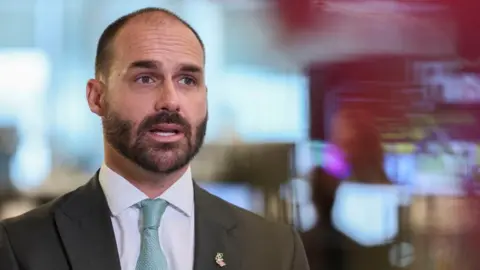
In a landmark ruling, Brazil’s Supreme Court sentenced 41‑year‑old Eduardo Bolsonaro to four years and two months in prison for lobbying U.S. authorities to intervene in his father’s coup trial.
The senator, who had lived in exile in the United States since 2025, was accused of urging Washington to impose tariffs and sanctions on Brazil while his father, Jair Bolsonaro, was found guilty of orchestrating a failed military coup.
Eduardo claims no formal summons was ever served and that the case was only brought to his attention through media reports, calling the conviction “baseless and senseless.”
His actions come amid a broader diplomatic spat: Trump’s July 2023 tariff on Brazilian goods was later withdrawn, and the U.S. Secretary of State Marco Rubio declared Washington would respond to Bolsonaro’s conviction, while the Brazilian government called U.S. sanctions on a Supreme Court justice “unacceptable interference” in its justice system.
The political drama feeds into Brazil’s struggle to maintain its environmental commitments. During the Bolsonaro era, Amazon deforestation accelerated, and the government’s climate commitments stalled. With the son of a former president now embroiled in legal woes, climate‑change policy remains vulnerable to political instability.
As Brazil navigates judicial and diplomatic challenges, the country’s capacity to pursue renewable energy, safeguard forest biodiversity, and meet its Paris Agreement targets will hinge on stable and transparent governance rather than partisan influence.