In brief
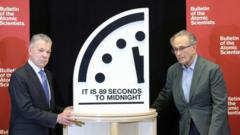
The Doomsday Clock has been moved forward to 89 seconds to midnight, the closest ever to destruction. The Bulletin of the Atomic Scientists cites nuclear threats, climate change, and advances in technology as critical factors, urging world leaders to take action.
The Doomsday Clock, a symbol of humanity's proximity to potential destruction, has been advanced by one second to now stand at 89 seconds to midnight, marking its closest point to annihilation ever recorded. This alarming adjustment was announced by the Bulletin of the Atomic Scientists (BAS), which attributes this grim reality to escalating nuclear threats, the misuse of emerging technologies—including artificial intelligence—and the ongoing crises associated with climate change.Daniel Holz, the chair of the Bulletin's Science and Security Board, emphasized that this latest clock setting serves as a "warning to all world leaders" about the urgent situation at hand. Since its inception in 1947, the clock has served as a telling symbol of existential threats, initially set at seven minutes to midnight. In the prior year, the clock remained unchanged at 90 seconds, but now represents an even greater urgency.In a statement issued on Tuesday, the BAS articulated: "By adjusting the clock one second closer to midnight, we send a stark signal." The organization expressed concern that the world is perilously close to crisis; thus, this minute change indicates extreme danger, urging immediate action as any further delay escalates the risk of a global catastrophe.The statement pointed to the ongoing war in Ukraine, which has now persisted for nearly three years since Russia launched its full-scale invasion. It cautioned that the situation could rapidly escalate to nuclear conflict due to impulsive decisions or unfortunate miscalculations. Furthermore, the report highlighted instability in the Middle East, warning of the potential for sudden and severe escalation into wider confrontations.The BAS's panel of scientists expressed disappointment at the grim "long-term prognosis" for addressing climate change, noting that many governments continue to lack the necessary financial resources and policy initiatives to effectively combat global warming. They also reiterated concerns regarding emerging and re-emerging diseases that loom as threats to economic stability, societal well-being, and global security.In addition to these pressing issues, the Bulletin highlighted recent advancements in disruptive technologies that enhance global dangers. The integration of artificial intelligence into military applications, particularly in conflict zones like Ukraine and the Middle East, has raised alarms. Moreover, the report calls attention to the destructive accompanies of misinformation and conspiracy theories, which exacerbate these crises by muddying the waters of truth.As the BAS emphasized, the collective responsibilities of the United States, China, and Russia loom large in reinstating global safety, stating that these nations possess the power to significantly alter the course of civilization. Their actions, or lack thereof, determine whether humanity can avert a catastrophic future.