In brief
In a recent interview, Ahmed al-Sharaa, leader of the victorious rebel forces against Bashar al-Assad, emphasized that Syria is exhausted from prolonged conflict and should not be seen as a danger to the international community. He called for sanctions imposed on Syria to be lifted and argued that his faction, Hayat Tahrir al-Sham, should be de-listed as a terrorist organization.
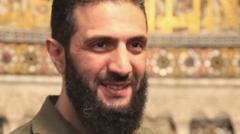
In a compelling interview with the BBC in Damascus, Ahmed al-Sharaa, the leader of the recently triumphant rebel faction Hayat Tahrir al-Sham (HTS), declared that Syria is not a threat to its neighbors or the Western world. He urged for sanctions on Syria to be lifted, noting that the country has endured years of devastating war and is now in need of support rather than reproach.Having led the rapid campaign that resulted in the toppling of the Assad regime less than two weeks ago, al-Sharaa emphasized the need for a peaceful and stable future for Syria. Calling himself by his real name rather than the wartime pseudonym of Abu Mohammed al-Jolani, he attempted to shift perceptions of HTS, which has been labeled a terrorist organization by the UN, US, EU, and UK due to its origins as a splinter group of al-Qaeda.Al-Sharaa argued that HTS is not a terrorist group, emphasizing that they do not target civilians or civilian areas, and instead view themselves as victims of Assad’s crimes. He drew a distinct line between the oppressed and the oppressors, asserting that the international community should differentiate between the two.Dismissing concerns about transforming Syria into another Afghanistan, al-Sharaa pointed out the cultural differences between the two nations, stating that Syria is distinguished by a unique societal framework and a commitment to education, particularly for women. He expressed a desire for reassurance regarding HTS's intentions, pledging to uphold rights and resist reverting to violent extremism.As the newly established leadership takes shape in Syria, observers anticipate whether they will deliver on promises of human rights and governance that respects the Syrian population. The forthcoming actions will be crucial in shaping the future of a war-weary nation seeking stability and rehabilitation.