In brief
The strike on Chernobyl's protective structure by a Russian drone has prompted warnings from both Ukrainian officials and the International Atomic Energy Agency regarding the stability of the facility. While no immediate radiation hazard has been confirmed, experts emphasize the gravity of the incident and its implications for nuclear safety amid ongoing military conflicts.
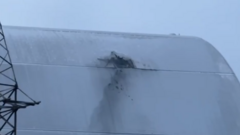
Ukrainian President Volodymyr Zelensky announced that a Russian drone struck the protective shelter over the Chernobyl nuclear reactor site, a location associated with the world's most catastrophic nuclear disaster. The overnight attack caused a fire; however, it was quickly extinguished, and according to the UN's International Atomic Energy Agency (IAEA), radiation levels remain normal and stable. Yet, concerns linger as Oleksandr Titarchuk, the plant's chief engineer, warned about the possibility of radioactive substance leakage arising from the incident.Russia has firmly denied claims of attacking Chernobyl, asserting that its military policies do not target Ukraine's nuclear infrastructure. The IAEA promptly dispatched firefighting personnel following the explosion, reporting that no casualties were recorded. Despite this, the agency has maintained high vigilance, with director Rafael Grossi stating that "there is no room for complacency."The 1986 Chernobyl explosion had globally severe consequences, triggering public health crises across Europe, including a notable rise in cancer cases in surrounding areas. The current shield is a monumental structure, standing 275 meters wide and 108 meters tall, built to secure the reactor from further radiation leaks for the upcoming century at a cost of $1.6 billion. Zelensky shared footage appearing to show the aftermath of the drone attack, illustrating significant damage to the shield. Hryhoriy Ishchenko, who heads the agency managing Chernobyl’s exclusion zone, cautioned that a shift of just 15 meters could have led to a radiation catastrophe. Experts in nuclear safety, including Professor Jim Smith from the University of Portsmouth, acknowledged the attack's severity but reassured that the risk of significant radiation exposure remains low due to robust containment structures below the damaged shield. Simon Evans, who previously oversaw the Chernobyl Shelter Fund, condemned the strike as an extraordinarily reckless act against a sensitive nuclear site, highlighting the collaborative global efforts that built the protective dome.Zelensky interpreted the attack as a signal that Russian President Vladimir Putin has no intentions of pursuing peace talks, particularly after suggestions that negotiations may be on the table. In the backdrop of these tensions, increased military activities have been noted surrounding the Zaporizhzhia Nuclear Power Plant, prompting alerts from the IAEA about possible dangers linked to military operations near nuclear facilities. Experts suggest a greater concern lies with Zaporizhzhia, where operational risks might arise due to the presence of live nuclear fuel, in contrast to the decommissioned state of Chernobyl's reactors. As investigations into the drone strike continue, the implications of ongoing military engagements on nuclear safety remain paramount amidst international anxieties surrounding the war in Ukraine.