In brief
The recent German elections saw Friedrich Merz's Christian Democrats secure a victory, albeit short of the desired 30% vote-share. Meanwhile, the far-right Alternative for Germany (AfD) achieved a record 20.8%. Despite the celebrations, the election has left many questions about Germany's political direction, highlighted by the mainstream parties' reluctance to engage with the far-right.
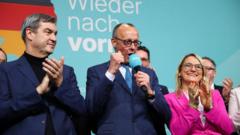
In a moment of celebration mixed with uncertainty, Friedrich Merz's conservative party emerged victorious in the recent German federal elections, winning ahead of rival parties but falling short of their anticipated 30% threshold. Addressing jubilant supporters, Merz acknowledged the significant responsibility now on his shoulders, stating, “Let’s celebrate tonight and in the morning we’ll get to work.” However, the atmosphere was less jubilant for the far-right Alternative for Germany (AfD), which took a historic second place with 20.8% of the vote, a bittersweet achievement as the party had anticipated a stronger result.As the electoral results rolled in during the early hours, it became apparent that the AfD performed particularly well in eastern Germany, achieving around 34% in some regions. Their candidate for chancellor, Alice Weidel, proclaimed, “Germans have voted for change,” while projecting that Merz’s coalition attempts would ultimately be fruitless and fresh elections might soon follow.The election brought an 83% turnout, the highest since before the reunification of Germany in 1990. However, while Merz’s Christian Democrats and their Bavarian allies garnered 28.6%, the other mainstream parties, including the Social Democrats who suffered their worst performance at 16.4%, left the political landscape fragmented.Merz is faced with the challenge of forming a coalition, with little prospect of collaborating with the AfD due to a longstanding taboo against mainstream parties aligning with the far-right. The only viable partners appear to be the Greens, a party Merz publicly dismissed as lacking substance.While Merz hopes to showcase strong leadership in Europe and bolster support for Ukraine, lingering concerns dominate the political climate. The open support for the AfD from notable figures such as Elon Musk has raised eyebrows, and President Trump’s congratulatory remarks on Merz’s victory highlight a growing transatlantic disconnect.Moreover, the challenge of attracting younger voters looms large, as the AfD and the Left party—previously struggling—have gained traction with engaging TikTok campaigns that resonate with the youth demographic. With the landscape shifting beneath them, the results pose daunting questions for the future political course of Germany and its role in Europe.