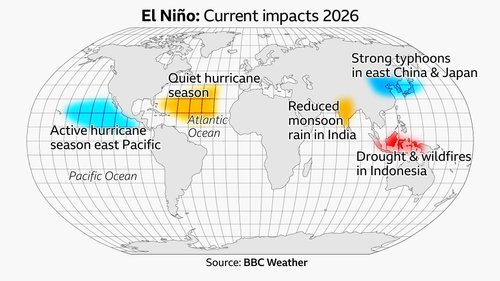
In brief
The 2026‑2027 El Niño has intensified heavy rainfall across the U.S. Southwest, leading to record‑breaking flash floods in Colorado and Arizona and raising nationwide concerns. Officials are urging residents to heed local advisories, consider flood insurance, and improve early warning systems as the storm season continues into spring.
In the past month, the warm‑water Pacific pattern of El Niño has intensified rainfall across the U.S. Southwest, sparking record flash floods in Colorado and Arizona and prompting officials to warn that the storm season may spread nationwide as the rains persist into spring.
According to a report by the Associated Press and the Atlantic Press Network, the El Niño phenomenon has produced an unusually heavy rainfall pattern that has overwhelmed reservoirs, streambanks, and urban drainage systems across the region. With heavy precipitation identified in March and expected to intensify in April, the storm season continues to roll in and could pose a nationwide risk by the summer months.
In Colorado, rivers have breached historic flood stages and levees have silted, sending water downstream toward towns that rely on irrigation and municipal water supplies. Air‑quality monitors also reported reddish‑brown sediments flowing into major valleys, complicating water treatment and causing health warnings for residents downstream. Arizona residents faced flash floods that caused multi‑sentence insurance claims, power outages, and damage to infrastructure that heavily depended on stormwater runoff systems.
"Officials have warned that the record floods in the Southwest could be an early sign of a larger nationwide response, especially since a strong El Niño typically amplifies the intensity of wet weather events across the country," the Associated Press said. Meanwhile, the Atlantic Press Network noted that the warm‑water Pacific pattern may persist throughout the year, amplifying the difficulty of predicting and preparing for future rainfall events.
NOAA has issued new advisories that highlight the heightened probability of heavy rain throughout March and April, and officials are revising early warning standards to reflect an increased frequency and intensity of floods. Residents in flooded areas of Arizona and Colorado are encouraged to follow local advisories closely and consider flood insurance as part of their relocation or property‑related decisions, the Atlantic Press Network advised. Officials also noted that the increased momentum of the Pacific’s temperature rise may add to the intensity of storms, emphasizing that awareness and preparedness are essential for mitigating damage from future fluvial events tied to El Niño.
Beyond flood damage, the current pattern has significant ecological impacts. Wetting of desert lands has spurred an over‑growth of invasive plant species, while local wildlife habitats have been altered by changes in streamflow and sediment deposition. Conservation groups are urging that mitigation plans include ecological monitoring so that built environments and growing ecosystems can coexist during periods of high water volume.
City planners and water‑resource agencies across Colorado and Arizona have begun to integrate flood risk maps into zoning and land‑use decisions. A new approach includes subtracting risk from potential future storm paths, thereby limiting development in true flood plains while encouraging the establishment of green infrastructure that can absorb excess water. Some counties are implementing sting‑track regulatory measures that limit the construction of new homes in high‑risk zones, and a portion of flood‑damaged waters is earmarked to support the development of permeable covers in parks and landscaping.
From the national perspective, the elevated risk is prompting a review of the current state of flood forecasting technology. Updated models are being tested across the Southwest, aiming to combine satellite imagery and ground sensor data to produce real‑time alerts for residents and authorities. Researchers also point to the emerging role of remote‑sensing satellites that can upload high‑resolution precipitation data to predictive models within minutes, an approach that could give communities a longer lead time to prepare for sudden rising waters.
As the new storm season presses on, there remains an ongoing debate among experts about the exact thresholds of precipitation that trigger flash‑flood events. The Atlantic Press Network acknowledges that planetary warming trends might also amplify the rainfall intensity associated with El Niño, meaning local thresholds for safe runoff levels could shift. Meteorologists argue that while El Niño plays a decisive role, the growing trend of global temperatures may also contribute to stronger storms and longer duration rainfall events across the west, requiring adaptive measures in both infrastructure and community planning.
Ultimately, as flood risk persists, the emphasis is on community readiness and policy adaptation. States are pushing for a coordinated flood‑preparedness effort that includes public education, improved drainage networks, flood‑resilient building codes, and the expansion of emergency notification systems. Taken together, these dual threads of issue‑based priority and broader climate change context illustrate how the 2026‑2027 El Niño has not only directed immediate hydrological impacts but also reshaped the conversation about sustainable resilience in the Southwest’s future flood risk profile.