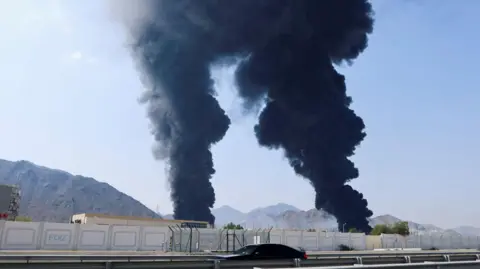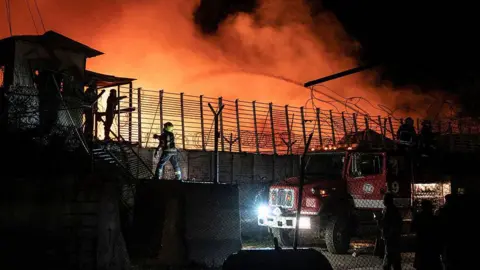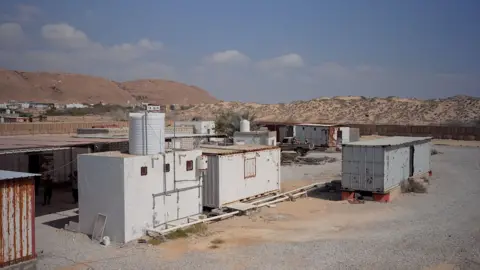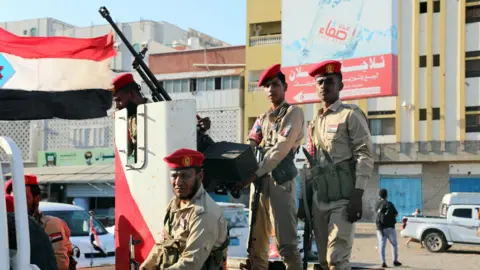
Saudi Arabia has backed a demand from Yemen's presidential council for the United Arab Emirates (UAE) to withdraw within 24 hours, after a Saudi-led coalition bombed what it said was a weapons shipment for UAE-backed separatists at the port of Mukalla.
The Saudi foreign ministry accused the UAE of 'pressuring' the Southern Transitional Council (STC), which seeks independence for southern Yemen, to launch recent offensives in the eastern provinces of Hadramawt and al-Mahra.
The kingdom would take measures to confront what it considered such 'highly dangerous' actions, it warned.
The UAE's foreign ministry denied that the shipment contained weapons and expressed 'deep regret' at the Saudi statement, condemning allegations of directing military operations against Saudi Arabia.
The STC rejected the Saudi ultimatum, asserting it would remain a 'main partner' in battling the Iran-backed Houthi movement, which controls much of north-western Yemen.
In a significant move, Yemen's presidential council, led by Rashad al-Alimi, announced the cancellation of a joint defence pact with the UAE and ordered the withdrawal of UAE forces, citing national interests and the urgency to safeguard security.
Alimi declared a state of emergency for 90 days, aimed at addressing threats posed by the Houthis and affiliated factions operating under UAE directives.
The Saudi-led coalition had earlier reported a 'limited' air strike aimed at military vehicles associated with the STC, which they claimed posed an imminent threat to stability. The UAE is maintaining its stance that the attacked shipments were for its forces in Yemen.
This escalation follows a history of complex alliances and conflicts in Yemen, where a civil war unleashed in 2014 has led to dire humanitarian conditions, with over 150,000 fatalities reported and ongoing battles between various factions in the region.
The STC, which emerged from the backdrop of Yemen's war, initially allied with the government against the Houthis but has since asserted its own governance over sections of southern Yemen, complicating the landscape of power and control amidst prolonged conflict.