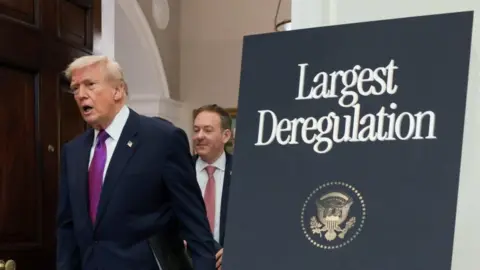
President Donald Trump recently heralded his administration's sweeping rollback of federal climate change policies as a monumental win against the Democrats' environmental platform. This announcement, made at the White House, marks a significant turning point in U.S. climate policy, specifically through the revocation of the 2009 'endangerment finding' that has underpinned various emissions-reduction efforts for nearly two decades.
During his remarks, Trump criticized the prior administration's climate policies, labeling them as part of a 'radical' agenda and tying the rollback to potential economic benefits for American consumers by reducing reliance on clean energy initiatives. He emphasized that empowering fossil fuel production would lead to lowered energy costs, directly appealing to a demographic concerned about economic stability as mid-term elections approach.
Accompanying Trump, Lee Zeldin, the head of the U.S. Environmental Protection Agency, described the 2009 ruling as a cornerstone of climate regulations that has burdened the U.S. economy with excessive regulations.
This change follows a persistent campaign by the Trump administration to dismantle climate policies established by previous administrations, including a withdrawal from the Paris Climate Agreement. Critics argue that this move could severely hinder the United States' ability to address the climate crisis, with former President Barack Obama voicing concerns about the potential long-term health and safety implications of such deregulations.
As Trump's administration seeks to rejuvenate its political positioning ahead of key elections, public sentiment surrounding climate change is crucial; recent polls indicate an increasing worry among Americans about global warming. This juxtaposition may create complications for the Republican strategy relying on Trump's climate achievements, particularly in light of evolving public attitudes toward environmental issues.
During his remarks, Trump criticized the prior administration's climate policies, labeling them as part of a 'radical' agenda and tying the rollback to potential economic benefits for American consumers by reducing reliance on clean energy initiatives. He emphasized that empowering fossil fuel production would lead to lowered energy costs, directly appealing to a demographic concerned about economic stability as mid-term elections approach.
Accompanying Trump, Lee Zeldin, the head of the U.S. Environmental Protection Agency, described the 2009 ruling as a cornerstone of climate regulations that has burdened the U.S. economy with excessive regulations.
This change follows a persistent campaign by the Trump administration to dismantle climate policies established by previous administrations, including a withdrawal from the Paris Climate Agreement. Critics argue that this move could severely hinder the United States' ability to address the climate crisis, with former President Barack Obama voicing concerns about the potential long-term health and safety implications of such deregulations.
As Trump's administration seeks to rejuvenate its political positioning ahead of key elections, public sentiment surrounding climate change is crucial; recent polls indicate an increasing worry among Americans about global warming. This juxtaposition may create complications for the Republican strategy relying on Trump's climate achievements, particularly in light of evolving public attitudes toward environmental issues.