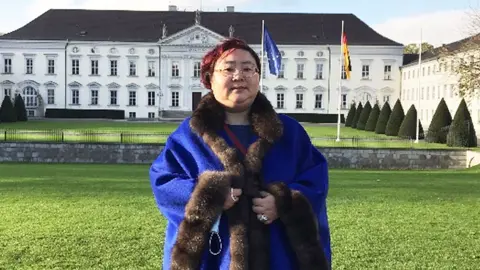
A woman, said by police to have bought cryptocurrency now worth billions of pounds using funds stolen from thousands of Chinese pensioners, is due to be sentenced this week for money laundering.
After fleeing China, she moved to a mansion in Hampstead, north London. The Metropolitan Police raided it a year later and made one of the world's single largest crypto seizures.
More than 100,000 Chinese people invested their money in her company - which claimed to be developing high-tech health products and mining cryptocurrency. In reality, she embezzled the funds, police say. As she awaits sentencing, investors have told the BBC World Service they hope to get at least some of their cash back from the UK authorities.
Anything left unclaimed would normally default to the UK government - leading some to speculate that the Treasury could stand to gain from the haul.
If we can gather all the evidence together, we hope the UK government, the Crown Prosecution Service and the High Court can show compassion, said one victim we are calling Mr Yu, who says his marriage failed as a result of the fraud. Because now, it's only that haul of Bitcoin [cryptocurrency] that can return us a little bit of what we lost.
Qian Zhimin, 47, arrived in the UK under a fake passport in September 2017, after Chinese police started investigating her.
She moved into a mansion on the edge of Hampstead Heath, at a rent of more than £17,000 ($22,700) a month. To pay for this, she needed to convert her Bitcoin stash back into money she could spend.
So she posed as a wealthy antiques and diamond heiress, and hired a former takeaway worker as her personal assistant, who she asked to trade the cryptocurrency into other assets, such as cash and property.
As Bitcoin rocketed in value, Qian could achieve what her company promised its investors - that they could 'get rich while lying down'. Her assistant Wen Jian - at her own trial last year, which culminated in a six-year jail term for money laundering - said Qian had spent most of her days lying in bed, gaming and online shopping.
But Qian was also drawing up a bold six-year plan for future schemes, according to her diary. Her notes outline plans to found an international bank, buy a Swedish castle, and even to ingratiate herself with a British duke.
Her grander stated objective was to become queen of Liberland, an unrecognised microstate on the Croatian-Serbian border, by 2022.
In the meantime, Qian had Wen look for houses she could buy in London. But her attempts to purchase an especially large property in Totteridge Common - an area known for its substantial, secluded residences - triggered a police investigation when Wen was unable to account for her boss's wealth.
Police raided Qian's Hampstead rental property and uncovered hard drives and laptops found to be loaded with tens of thousands of Bitcoin - believed to be the single largest cryptocurrency seizure in UK history.
Qian had set up the company through which money was embezzled just four years earlier, in her native China. Lantian Gerui, or Bluesky Greet in English, claimed to use investors' money to mine - or generate - new Bitcoin, and to invest in a range of pioneering technological devices.
But UK police believe this was an elaborate scam, and that Qian's company was simply using promises of high profits to pull more and more investors into the scheme.
One of her investors, Mr Yu, says he never suspected anything was wrong because the company drip-fed him a portion of his apparent earnings - just over 100 yuan ($14, £10) - every day.
Investors saw their daily payouts topped up for each new person they signed up. This helped the scam reach some 120,000 people, based in every one of China's provinces, according to documents from trials in China of the company's official promoters. Their deposits totalled more than 40bn yuan ($5.6bn, £4.2bn), the UK's Crown Prosecution Service (CPS) has found.
A Chinese police investigation into Lantian Gerui, launched in mid-2017, signalled the beginning of the end for Qian's scheme.
Mr Li told the BBC this offered victims a 'glimpse of sunlight'.
The cryptocurrency Qian brought to the UK has multiplied more than 20 times in value since her arrival. Its fate will be decided by a civil 'proceeds of crime' case that will start in earnest early next year.
Despite leading this high-profile enterprise, Qian was notoriously secretive, known only as Huahua or Little Flower to her clients, and communicating with them largely through the poems she posted on her blog.
The toll on Mr Yu - whose wife invested alongside him - has not just been financial, but personal, culminating in divorce and little contact with his son, he told the BBC.
Still, he considers himself relatively lucky. One lawyer we spoke to said many of Qian's investors were left without money for food or medicine.
Mr Yu knew one such person - from Tianjin, northern China. She died of breast cancer after discharging herself from hospital, unable to afford treatment, he said.
Mr Yu says he kept his word and wrote a poem in her memory which he posted online. It ends with the lines:
'Let us be pillars, holding up the sky / Rather than sheep, to be led and misled / To those who survive - strive harder / That we might right this grave injustice.'
}