In brief
The global economy is set to experience a significant slowdown due to ongoing tariff disruptions, as highlighted by the IMF's prediction of a decline in growth to 3.1% in 2026. Despite some resilience in the US economy, tariffs have raised business costs, increased uncertainty, and resulted in more trade restrictions between major economies. The complexities of these tariff policies continue to pose challenges for international trade, particularly between the US and China.
President Trump's favourite word is tariffs. He reminded the world of that in his pre-Christmas address to the nation.
With the world still unwrapping the tariffs gift from the first year of his second term in office, he said they were bringing jobs, higher wages and economic growth to the US.
That is hotly contested. What is less debatable is that they've refashioned the global economy, and will continue to do so into 2026.
The International Monetary Fund (IMF) says that although the tariff shock is smaller than originally announced, it is a key reason why it now expects the rate of global economic growth to slow to 3.1% in 2026. A year ago, it predicted a 3.3% expansion this year.
For the head of the IMF, Kristalina Georgieva, things are better than we feared, worse than it needs to be. Speaking on a podcast recently she explained that growth had fallen from a pre-Covid average of 3.7%.
This growth is too slow to meet the aspirations of people around the world for better lives, she said.
Other forecasts for 2026 are even more pessimistic than that of the IMF.
Yet the impact of the tariffs on the global economy was not as bad as it could have been, notes Maurice Obstfeld of the Peterson Institute for International Economics, who is also a former chief economist at the IMF. He says this is the case because countries didn't retaliate strongly against the US.
However, after five rounds of trade talks, the world's two biggest economies still have more tariffs and other trade restrictions in place against each other than when Trump took office for the second time.
The tariffs have pushed up costs for many businesses and increased uncertainty, which makes it harder to plan for and invest in the future.
Despite the resilience seen so far, these frictions and uncertainties take their toll over time, such as through efficiency losses, according to Obstfeld.
Some of the damage of tariffs has been mitigated by lower interest rates, a fall in the value of the dollar, businesses finding clever ways around them, and, crucially, the many exemptions they contain.
This may help explain why the UN trade agency UNCTAD is forecasting that the value of global trade grew 7% last year to reach more than $35tn (£26tn).
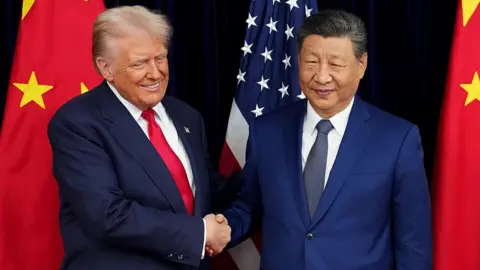
Tariffs, US sourcing of rare earth metals, and Chinese access to high-end US computer chips, have dominated talks between the two sides, but there are many other issues to be resolved when Xi hosts Trump in April.