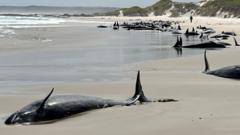
Australian officials have taken the difficult step of euthanizing around 90 false killer whales, part of a larger pod that became stranded on a remote beach in Tasmania's north-western region. This somber decision comes after experts determined that rescue efforts were unfeasible due to the challenging conditions at the site near Arthur River, where over half of the 157 stranded whales had already died.
The impacted whales are known as false killer whales, which are actually one of the largest species within the dolphin family. They can reach lengths of up to 6 meters and weigh as much as 1.5 tonnes. Stranding incidents involving this species have rarely happened in Tasmania over the past fifty years, although the region has experienced a troubling rise in mass strandings of various whale species.
Survivors were discovered by local resident Jocelyn Flint, who recounted her experience at the site, describing the scene as heartrending. "There are babies... There's just families of them. Their eyes are open, they're looking at me, like 'help'."
Notably, the stranding site is exceptionally hard to reach, posing significant logistical challenges for rescue operations. Marine biologist Kris Carlyon described it as one of the most challenging locations he has encountered in his extensive career. With difficult terrain complicating access, attempts to tow two stranded whales back to the water were unsuccessful, leaving authorities with little choice.
Amidst this bleak situation, weather forecasts predict similar challenging conditions over the next two days, prompting veterinarians to make the painful decision to proceed with euthanasia to prevent further suffering. Dr. Carlyon remarked, "The longer these animals are out stranded, the longer they are suffering. All alternative options have been unsuccessful, euthanasia is always a last resort."
The euthanasia process is expected to begin imminently, with plans still being finalized on how to handle the disposal of the carcasses. Given the area's significance to Indigenous cultural heritage, some officials suggested that allowing nature to take its course may be a suitable resolution.
Concerns for public safety have led authorities to request that enthusiasts and bystanders avoid the stranded site, particularly due to nearby bushfires and difficult travel conditions. Tasmania accounts for over 80% of Australia's whale strandings, frequently clustered along its rugged west coast. The tragedy echoes previous incidents, such as in 2020 when more than 470 pilot whales stranded in Macquarie Harbour, sparking significant rescue attempts that ultimately failed to save the majority.
Understanding the reasons behind mass strandings remains complicated, with theories ranging from disorientation from following prey to the possibility of one whale inadvertently steering an entire pod ashore. Research into these events remains critical as conservation efforts strive to protect these highly social marine mammals and their habitats.